The windows are open in the house.
The sunlight of a breezy May evening tosses branch- and leaf-shaped shadows across the books along my shelves.
No matter what concerns exercised my heart and mind this week, a great beautiful day has arisen in these last few hours.
The decision to postpone dinner until I had sat with the day, its quiet and the bold Lord of its hopes was taken at first, I confess, hesitantly.
I have these words, though, now and I offer them for what they say of sudden comfort and surprise.

Friday, May 23, 2008

Sunday, May 18, 2008
Tea and Madeleines
There’s a distinctive pleasure to a visit with a friend who knew you in your twenties.
Yesterday morning I had a pot of tea and – appropriately – two madeleines on the table in front of me. The spring weather had moved into a sunny mode, and other customers who strolled into the coffee shop, sitting at tables around Steve and me, were in a good mood.
Two men in their fifties, Steve and I have a common history on which to draw in our conversations. We were both students for the ministry three decades ago, and we make easy allusions to people who taught us and advised us and studied with us in that earlier chapter of our lives. Two gay men, we share a perspective on the experience of church that has evolved over the years. We will see one another at services later this morning.
When people know one another in their twenties, there is a shared landscape that remains fresh and ready for their later reflections on life’s mysteries and questions. What might take long, nuanced explanations to make real to someone you meet in your thirties or forties or fifties can rise around you as effortlessly real as the morning sunlight out of which you have just walked on a Saturday in May.
A topic into which Steve and I delved yesterday over our madeleines was the discernment process by which we had each of us separately come to the decision almost thirty years ago to abandon a career in ministry.
It had not been for either of us a simple or obvious step to take. We had each of us grown up with a solid admiration for the men who had embraced this life and lived this lofty vocation. We had made close friendships with men who shared so many of the key values by which we ourselves wanted to live and grow spiritually and intellectually. So many practical questions about our lives had gotten answered by deciding to pursue the goal of celibate ministry.
It’s just that we were gay. And there were things we might soon be ready to do and be that weren’t the stuff of seminary catalogues and brochures. I had even begun to see a divinity student named Ken from a nearby university.
The focus of yesterday’s conversation, however, was not the ways we had each of us eventually claimed our identity as gay men and as people of faith and prayer. Rather, it was the way we had each of us faced the daunting prospect of changing our lives, no matter the reason, no matter the precise circumstances.
When and how had it happened that a discernment process earnestly and sometimes fearfully pursued with spiritual directors and formation superiors arrived at the awareness that – well, that it was time, that it was right to go?
I offered the memory of having secretly waited through session after session with spiritual counselors for some dramatic enlightenment – Paul-at-Damascus style – that I was no longer required to pursue the ministerial path I had selected years earlier. Wasn’t clarity going to be blinding and undeniable? How else would I be free to go? How else could I expect the people around me to understand that of course a good man like John might leave the celibate ministry if it meant being true to himself?
It had been an almost random conversation with my spiritual director one evening after a community dinner that surprisingly completed the long discernment process. He asked to talk to me, and we sat in my room while the noises of clean-up in the kitchen drifted up the stairs. He was kind. He was thoughtful. At a certain point he simply asked what kind of evening I would prefer to be having – an evening with the community like the one that was going on downstairs or an evening with a special someone like Ken. It was a simple question to answer at that point. I admitted to an affection for the people downstairs, but I would prefer being with Ken – or someone like him – exploring a different kind of evening, engaging in a different kind of conversation.
My spiritual director smiled quietly. “Well,” he said, “there’s the answer you’ve been searching for.”
I stared at him a little in disbelief. No, I was ready to tell him, I was simply telling you what I would want to do. Wasn’t there a bigger question than that for me to answer?
It turns out there wasn’t. Not in the mind of this wise spiritual director.
 Now thirty years later, and Steve was facing me across the pot of tea and the madeleines. He had listened to my narrative before offering his own. It was a landscape through which we had both traveled years ago, but its simplicity rising around us on a sunny morning in May could still prove disarming.
Photo of a madeleine from Blue Vicar
Yesterday morning I had a pot of tea and – appropriately – two madeleines on the table in front of me. The spring weather had moved into a sunny mode, and other customers who strolled into the coffee shop, sitting at tables around Steve and me, were in a good mood.
Two men in their fifties, Steve and I have a common history on which to draw in our conversations. We were both students for the ministry three decades ago, and we make easy allusions to people who taught us and advised us and studied with us in that earlier chapter of our lives. Two gay men, we share a perspective on the experience of church that has evolved over the years. We will see one another at services later this morning.
When people know one another in their twenties, there is a shared landscape that remains fresh and ready for their later reflections on life’s mysteries and questions. What might take long, nuanced explanations to make real to someone you meet in your thirties or forties or fifties can rise around you as effortlessly real as the morning sunlight out of which you have just walked on a Saturday in May.
A topic into which Steve and I delved yesterday over our madeleines was the discernment process by which we had each of us separately come to the decision almost thirty years ago to abandon a career in ministry.
It had not been for either of us a simple or obvious step to take. We had each of us grown up with a solid admiration for the men who had embraced this life and lived this lofty vocation. We had made close friendships with men who shared so many of the key values by which we ourselves wanted to live and grow spiritually and intellectually. So many practical questions about our lives had gotten answered by deciding to pursue the goal of celibate ministry.
It’s just that we were gay. And there were things we might soon be ready to do and be that weren’t the stuff of seminary catalogues and brochures. I had even begun to see a divinity student named Ken from a nearby university.
The focus of yesterday’s conversation, however, was not the ways we had each of us eventually claimed our identity as gay men and as people of faith and prayer. Rather, it was the way we had each of us faced the daunting prospect of changing our lives, no matter the reason, no matter the precise circumstances.
When and how had it happened that a discernment process earnestly and sometimes fearfully pursued with spiritual directors and formation superiors arrived at the awareness that – well, that it was time, that it was right to go?
I offered the memory of having secretly waited through session after session with spiritual counselors for some dramatic enlightenment – Paul-at-Damascus style – that I was no longer required to pursue the ministerial path I had selected years earlier. Wasn’t clarity going to be blinding and undeniable? How else would I be free to go? How else could I expect the people around me to understand that of course a good man like John might leave the celibate ministry if it meant being true to himself?
It had been an almost random conversation with my spiritual director one evening after a community dinner that surprisingly completed the long discernment process. He asked to talk to me, and we sat in my room while the noises of clean-up in the kitchen drifted up the stairs. He was kind. He was thoughtful. At a certain point he simply asked what kind of evening I would prefer to be having – an evening with the community like the one that was going on downstairs or an evening with a special someone like Ken. It was a simple question to answer at that point. I admitted to an affection for the people downstairs, but I would prefer being with Ken – or someone like him – exploring a different kind of evening, engaging in a different kind of conversation.
My spiritual director smiled quietly. “Well,” he said, “there’s the answer you’ve been searching for.”
I stared at him a little in disbelief. No, I was ready to tell him, I was simply telling you what I would want to do. Wasn’t there a bigger question than that for me to answer?
It turns out there wasn’t. Not in the mind of this wise spiritual director.
 Now thirty years later, and Steve was facing me across the pot of tea and the madeleines. He had listened to my narrative before offering his own. It was a landscape through which we had both traveled years ago, but its simplicity rising around us on a sunny morning in May could still prove disarming.
Photo of a madeleine from Blue Vicar
Wednesday, May 14, 2008
It's About Yes...
Back in December I had begun an Advent practice of sitting more regularly with prayer in the evenings. After a few days of hospitalization, I had sensed that I was entering a new time in my life. I would do well, I told myself, to place myself in God’s presence in the lively expectation of hearing things that I needed to hear.
The seeds of that expectation had been sown during the summer. On an evening of retreat, I had walked beside a pond and berated God for playing with my heart at times. It was an unusual stance for me to take in prayer. In response, I distinctly heard a question posed within: “What do you want?” The question seemed to come from that place in my heart where I usually listened for God's guidance or comfort.
Through the season of Advent I had copied down sayings that came from that place during my evenings of prayer. This winter’s early Lent sent me back into those evenings. With the great feast of Pentecost this past Sunday, I typed out the sayings I had collected in my prayer book since Ash Wednesday. I present them here in the event that they speak to others who are readers of Writing Cabin.
You need this.
You need me.
February 6, Ash Wednesday
There’s no problem here.
February 8
Not yet, not yet, not yet.
February 11
What you do matters.
I want you to be happy.
February 15
This you will always have.
Me you will always have.
February 22
This isn’t about how, it’s about yes.
February 23
Nothing has to get done.
Sip each day’s peace.
March 1
Rest. Don’t figure this out.
March 7
I want you wholly awake.
March 10
What is your heart’s desire?
March 11
Let me be the joy in your heart –
believe in my guidance.
March 15
You’re not the only one
who wants what is good for you.
April 12
All love is well given.
Take it all.
April 21
Say thank you.
May 4
Lazarus, come forth!
May 10

Two Warm Trees by Willoughby Elliott from Harrison Gallery
The seeds of that expectation had been sown during the summer. On an evening of retreat, I had walked beside a pond and berated God for playing with my heart at times. It was an unusual stance for me to take in prayer. In response, I distinctly heard a question posed within: “What do you want?” The question seemed to come from that place in my heart where I usually listened for God's guidance or comfort.
Through the season of Advent I had copied down sayings that came from that place during my evenings of prayer. This winter’s early Lent sent me back into those evenings. With the great feast of Pentecost this past Sunday, I typed out the sayings I had collected in my prayer book since Ash Wednesday. I present them here in the event that they speak to others who are readers of Writing Cabin.
You need this.
You need me.
February 6, Ash Wednesday
There’s no problem here.
February 8
Not yet, not yet, not yet.
February 11
What you do matters.
I want you to be happy.
February 15
This you will always have.
Me you will always have.
February 22
This isn’t about how, it’s about yes.
February 23
Nothing has to get done.
Sip each day’s peace.
March 1
Rest. Don’t figure this out.
March 7
I want you wholly awake.
March 10
What is your heart’s desire?
March 11
Let me be the joy in your heart –
believe in my guidance.
March 15
You’re not the only one
who wants what is good for you.
April 12
All love is well given.
Take it all.
April 21
Say thank you.
May 4
Lazarus, come forth!
May 10

Two Warm Trees by Willoughby Elliott from Harrison Gallery
Monday, May 5, 2008
Scarlet Tanager and Rose-breasted Grosbeak
We are reconciled, I think,
to too much.
Better to be a bird, like this one --
an ornament of the eternal.
from "The Lark" by Mary Oliver
 It is hard to learn things about yourself when you have given yourself the benefit of the doubt for so long.
No one should be running to a dictionary whenever an unknown vocabulary word shows up in a reading passage, right? Hard-learned lessons teach us how to sketch out a meaning from context rather than let ourselves be consistently derailed by every unfamiliar term. The skill with which we pick up the thread of meaning later in the sentence or later in the paragraph justifies that judicious move forward over a text. Our education allows us to do this verbal fast-forward again and again without our – usually – suspecting that we have deprived ourselves of anything essential.
 Marc last week asked me out of the blue who my favorite authors were. Tempted at first to review the literary canon that acts as the underpinning of my undergraduate and graduate degrees in French and English and theology, I opted instead to name the two authors whose works I would automatically pick up from my bedside table if the volumes were there: contemporary American poet Mary Oliver and American naturalist Edwin Way Teale.
I think of myself as their loyal champion, a devotee, a spiritual younger brother. I trust them, I trust their worlds, I trust their words. I subscribe to the values enshrined in their writing.
 However, I was startled recently to come across a chapter by Edwin Way Teale that left my mind’s eye feeling blind. In descriptions of his Connecticut farm, I kept coming across the names of birds whose color and shape I could not picture. On one page he mentioned wood thrush and veery, purple finch and catbird and scarlet tanager, yellowthroat and rose-breasted grosbeak and chestnut-sided warbler and great crested flycatcher. On the next page he catalogued the presence on his farm of phoebe and flicker and towhee and meadowlark, barn swallow and woodcock and nighthawk.
My mind nodded through the lists. Yes, these were birds with wings, birds who sang and built nests and flew south. I was attentive to how Teale described them and their habits in the meadows around his house. On the other hand, I kept substituting a new mental marker whenever the name of a different bird was mentioned. In time the mental markers were perched on a clothesline, and I may as well have been picturing the caricatures in a New Yorker cartoon. I wondered what I was missing.
 Was I missing anything essential by not knowing the realities behind the markers? Were there compelling reasons to slow down my reading just because the words were technical or unfamiliar? A Google search for images to match the markers in Teale’s chapter gave me my answer.
What had made me think earlier that I could remain ignorant of this beauty? How long had I succeeded in relegating this startling display of nature’s richness to the background of my knowledge of this world? I am missing something, I know now. And there has to be something I can do not to miss it anymore.
 Photos (top to bottom) of Chestnut-sided Warbler, Rose-breasted Grosbeak, Eastern Bluebird, Blackburnian Warbler, and Scarlet Tanager from Mentor Lagoons
to too much.
Better to be a bird, like this one --
an ornament of the eternal.
from "The Lark" by Mary Oliver
 It is hard to learn things about yourself when you have given yourself the benefit of the doubt for so long.
No one should be running to a dictionary whenever an unknown vocabulary word shows up in a reading passage, right? Hard-learned lessons teach us how to sketch out a meaning from context rather than let ourselves be consistently derailed by every unfamiliar term. The skill with which we pick up the thread of meaning later in the sentence or later in the paragraph justifies that judicious move forward over a text. Our education allows us to do this verbal fast-forward again and again without our – usually – suspecting that we have deprived ourselves of anything essential.
 Marc last week asked me out of the blue who my favorite authors were. Tempted at first to review the literary canon that acts as the underpinning of my undergraduate and graduate degrees in French and English and theology, I opted instead to name the two authors whose works I would automatically pick up from my bedside table if the volumes were there: contemporary American poet Mary Oliver and American naturalist Edwin Way Teale.
I think of myself as their loyal champion, a devotee, a spiritual younger brother. I trust them, I trust their worlds, I trust their words. I subscribe to the values enshrined in their writing.
 However, I was startled recently to come across a chapter by Edwin Way Teale that left my mind’s eye feeling blind. In descriptions of his Connecticut farm, I kept coming across the names of birds whose color and shape I could not picture. On one page he mentioned wood thrush and veery, purple finch and catbird and scarlet tanager, yellowthroat and rose-breasted grosbeak and chestnut-sided warbler and great crested flycatcher. On the next page he catalogued the presence on his farm of phoebe and flicker and towhee and meadowlark, barn swallow and woodcock and nighthawk.
My mind nodded through the lists. Yes, these were birds with wings, birds who sang and built nests and flew south. I was attentive to how Teale described them and their habits in the meadows around his house. On the other hand, I kept substituting a new mental marker whenever the name of a different bird was mentioned. In time the mental markers were perched on a clothesline, and I may as well have been picturing the caricatures in a New Yorker cartoon. I wondered what I was missing.
 Was I missing anything essential by not knowing the realities behind the markers? Were there compelling reasons to slow down my reading just because the words were technical or unfamiliar? A Google search for images to match the markers in Teale’s chapter gave me my answer.
What had made me think earlier that I could remain ignorant of this beauty? How long had I succeeded in relegating this startling display of nature’s richness to the background of my knowledge of this world? I am missing something, I know now. And there has to be something I can do not to miss it anymore.
 Photos (top to bottom) of Chestnut-sided Warbler, Rose-breasted Grosbeak, Eastern Bluebird, Blackburnian Warbler, and Scarlet Tanager from Mentor Lagoons
Wednesday, April 30, 2008
Discerning the Way
A colleague came into my office yesterday afternoon with something she thought I would want to read. It was a passage from a new book by Quaker writer J. Brent Bill. This colleague and I have had conversations over the years on the topic of spiritual direction and spiritual discernment. I would like to think that the message in the introductory chapter of Sacred Compass: The Way of Spiritual Discernment will speak to a number of readers of Writing Cabin.
"A compass, no matter what direction we turn, always points us to the north pole – a destination most of us (unless we’re named Amundsen, Byrd, Peary, or Henson) will never reach in this lifetime. In that way, a compass makes a good metaphor for our spiritual lives and the work of discerning God’s will for us…
"Learning to follow the divine compass means stopping and paying attention instead of looking for a magical map with the shortest route highlighted in yellow. Learning what God wants of us means letting the Holy Spirit guide us into the deep places of our souls. We learn to look for God in those deep places and in all the places our lives take us.
 "When we travel through life attentive to the sacred compass, we find that God’s direction changes us. We discover that spiritual discernment is about sensing the presence and call of God, and not just about making decisions. …true transformation happens when we let the map (and any idea of a map) flutter from our tight grasp and instead begin to use the sacred compass that God provides – the compass of the Holy Spirit’s work within us."
From "Introduction" to Sacred Compass: The Way of Spiritual Discernment by J. Brent Bill
Image of Casper Friedrich's Wanderer Above a Sea of Fog from Boston College
"A compass, no matter what direction we turn, always points us to the north pole – a destination most of us (unless we’re named Amundsen, Byrd, Peary, or Henson) will never reach in this lifetime. In that way, a compass makes a good metaphor for our spiritual lives and the work of discerning God’s will for us…
"Learning to follow the divine compass means stopping and paying attention instead of looking for a magical map with the shortest route highlighted in yellow. Learning what God wants of us means letting the Holy Spirit guide us into the deep places of our souls. We learn to look for God in those deep places and in all the places our lives take us.
 "When we travel through life attentive to the sacred compass, we find that God’s direction changes us. We discover that spiritual discernment is about sensing the presence and call of God, and not just about making decisions. …true transformation happens when we let the map (and any idea of a map) flutter from our tight grasp and instead begin to use the sacred compass that God provides – the compass of the Holy Spirit’s work within us."
From "Introduction" to Sacred Compass: The Way of Spiritual Discernment by J. Brent Bill
Image of Casper Friedrich's Wanderer Above a Sea of Fog from Boston College
Monday, April 28, 2008
Spring Awakening
There are some kinds of conversations that catch you off guard.
Or rather they sit surprisingly well with you when you might never have thought you could listen calmly to what someone was telling you.
A friend, a one-time colleague whom I have known for over ten years, called me this past week.
She wanted to tell me about a Sunday afternoon she had spent with a friend. The quality of the time she spent with her was out of the ordinary in her life. It left her smiling, she said, uncontrollably and continually. It made the household to which she was returning in a few hours' time and the commitments that bound her to the people who shared that household with her no longer the only important thing in her life.
And I think that startled her.
And I think she knew that it might startle me.
And I may have been one of the few people that she could comfortably risk startling with the degree of her own surprise. And delight. And hunger.
My own life, I realize afresh, relishes those moments when someone tells me where space and possibility and unexpected joy have appeared in their life, opening them to how much bigger their lives might one day be.

Photo from Slow Muse
Or rather they sit surprisingly well with you when you might never have thought you could listen calmly to what someone was telling you.
A friend, a one-time colleague whom I have known for over ten years, called me this past week.
She wanted to tell me about a Sunday afternoon she had spent with a friend. The quality of the time she spent with her was out of the ordinary in her life. It left her smiling, she said, uncontrollably and continually. It made the household to which she was returning in a few hours' time and the commitments that bound her to the people who shared that household with her no longer the only important thing in her life.
And I think that startled her.
And I think she knew that it might startle me.
And I may have been one of the few people that she could comfortably risk startling with the degree of her own surprise. And delight. And hunger.
My own life, I realize afresh, relishes those moments when someone tells me where space and possibility and unexpected joy have appeared in their life, opening them to how much bigger their lives might one day be.

Photo from Slow Muse
Friday, April 18, 2008
Books and Binding
If you grew up loving books, you might – like me – have dreamed of becoming a writer one day.
On the other hand, you might have grown up loving books and never once entertained the notion of binding a book on your own.
My favorite teachers in school read aloud to me, and I watched them opening the covers of books and turning the pages, sometimes holding them open to show an artist's illustrations as I listened to the text being read aloud. My eyes enjoyed the familiar shape of the pages fanning out, rippling in waves until the teacher's fingers flattened the pages and steadied them.
I understood that not all books lay flat, that new books especially had pages that wanted to balloon, to bounce, to dive back and rest safely inside the covers again. I understood that this tendency had something to do with the spine of the book (I didn’t know it was called a spine), some mechanism tightly knit and ordinarily hidden under the extended fabric of the cover.
I early learned to envy the skill of the writers of books. On the other hand, I acknowledged the power wielded by books’ illustrators without ever hoping to wield it myself, and I had no idea who the shadowy individuals might be who knew how to keep pages together inside a book's covers.
I had exceptional luck with writing. I discovered that emulating successful artisans of words was helpful in my doing well in school. With deft circumlocution I managed to explore things in my personal journal that could pass the censure of nosy family members. In my first years in seminary, I even wrote weekly letters to my parents that succeeded in sounding as though we had regularly and warmly communicated everything that was important to us in the years before my entering.
Sad to say, those letters were largely works of fiction. I confessed as much to my friend Michael when we visited last month in New Orleans. An English teacher, Michael is used to commenting on someone’s writing, and the letter he sent me the week after my trip was a gift of characteristic insight and generosity:
One thought that has occurred to me is how your own exquisite writing skills themselves, ironically, belie a deeper turmoil. Your carefully measured prose, your perceptive and nuanced reflections hint at a well-ordered inner house. But these, I think you would now tell me, are (have been) the scaffolding holding up some disrepair. Writing has been one tool, among others I am sure, of survival. I am glad you have that tool. I hope you find many others.
A consoling and emboldening thought: the many other tools of survival that may be available to this inveterate wordsman. So here…

What I have recently begun to explore is the craft of bookbinding. In my fifties I have uncovered in myself a fascination with the ways books hold physically what those of us who craft sentences and paragraphs dream of preserving in them. Borrow an image from my friend Michael, and you might say that I am setting my hand to creating the physical scaffolding for the writing and reading that have been lifelines for me.
On a Saturday morning two weeks ago, I stood at a bookbinder’s workbench in a local crafts school and began. It was important to feel myself in a new environment and at a new task. It was reassuring to look around me and see nothing familiar and be able to listen to what my hands and eyes wanted to say with the materials before me.
I am proud of what I have managed.
Photo uploaded from CJ's Woodland Shed
On the other hand, you might have grown up loving books and never once entertained the notion of binding a book on your own.
My favorite teachers in school read aloud to me, and I watched them opening the covers of books and turning the pages, sometimes holding them open to show an artist's illustrations as I listened to the text being read aloud. My eyes enjoyed the familiar shape of the pages fanning out, rippling in waves until the teacher's fingers flattened the pages and steadied them.
I understood that not all books lay flat, that new books especially had pages that wanted to balloon, to bounce, to dive back and rest safely inside the covers again. I understood that this tendency had something to do with the spine of the book (I didn’t know it was called a spine), some mechanism tightly knit and ordinarily hidden under the extended fabric of the cover.
I early learned to envy the skill of the writers of books. On the other hand, I acknowledged the power wielded by books’ illustrators without ever hoping to wield it myself, and I had no idea who the shadowy individuals might be who knew how to keep pages together inside a book's covers.
I had exceptional luck with writing. I discovered that emulating successful artisans of words was helpful in my doing well in school. With deft circumlocution I managed to explore things in my personal journal that could pass the censure of nosy family members. In my first years in seminary, I even wrote weekly letters to my parents that succeeded in sounding as though we had regularly and warmly communicated everything that was important to us in the years before my entering.
Sad to say, those letters were largely works of fiction. I confessed as much to my friend Michael when we visited last month in New Orleans. An English teacher, Michael is used to commenting on someone’s writing, and the letter he sent me the week after my trip was a gift of characteristic insight and generosity:
One thought that has occurred to me is how your own exquisite writing skills themselves, ironically, belie a deeper turmoil. Your carefully measured prose, your perceptive and nuanced reflections hint at a well-ordered inner house. But these, I think you would now tell me, are (have been) the scaffolding holding up some disrepair. Writing has been one tool, among others I am sure, of survival. I am glad you have that tool. I hope you find many others.
A consoling and emboldening thought: the many other tools of survival that may be available to this inveterate wordsman. So here…

What I have recently begun to explore is the craft of bookbinding. In my fifties I have uncovered in myself a fascination with the ways books hold physically what those of us who craft sentences and paragraphs dream of preserving in them. Borrow an image from my friend Michael, and you might say that I am setting my hand to creating the physical scaffolding for the writing and reading that have been lifelines for me.
On a Saturday morning two weeks ago, I stood at a bookbinder’s workbench in a local crafts school and began. It was important to feel myself in a new environment and at a new task. It was reassuring to look around me and see nothing familiar and be able to listen to what my hands and eyes wanted to say with the materials before me.
I am proud of what I have managed.
Photo uploaded from CJ's Woodland Shed
Friday, April 11, 2008
Early Chapters and Late
No one has the relationship to the little boy in the picture below that I do. It is a photograph from one of four albums that my mother prepared thirty years ago, one album for each of my three brothers and one for me. Without retaining any memory of the occasion on which the photograph was “snapped,” I know that it is a picture of me returning from school one day.
 I presume the person who took this photograph was either my father or my mother, standing between the two lugustrum shrubs that flanked our front walkway in New Orleans. I can’t claim to know for sure why I am running. We didn’t ordinarily use the front door of our house; it led into a formal living room that was carpeted, and my brothers and I were normally not permitted through it when we first came home from school. Perhaps we had unexpected family visitors that day, and I was heading as fast as I could to the back door of our house to get into the house and greet them.
When my parents died, two people vanished who could effortlessly link in their minds the child in the picture of that school day with the grown man forty years later entering their home on visits two and three times a year and driving them to doctors’ offices and picking up meals for them at the nearby Piccadilly Cafeteria. It is hard for me to realize that they could have watched me walking through their house during those visits and pictured in their mind earlier times when I had walked through without a beard, without a job, without Marc.
In the entry hall of our house, there is a photograph of Marc and me from a visit we had made to New Orleans the first summer after we moved in together. We are on our way to breakfast at Brennan’s. Marc is wearing a seersucker suit, and I have my yellow tie and blue shirt and grey flannels. We are flush with the excitement of a warm welcome from my family and a sense of something working out in our lives that we might sometimes have despaired of ever seeing.
To my eyes over twenty years later on the eve of our anniversary, these two men in their mid-thirties look young.
I marvel that there are people in our lives now who can effortlessly link in their minds the picture of Marc and me on our way to Brennan’s with the men twenty years later welcoming them into our home and eating with them around the dining room table. I pause in wonder that friends and family can watch Marc and me walking through our home during their visits and can picture in their mind the earlier times when we all of us walked through other homes, talked through other jobs, and tried to glimpse the future chapters of our lives.
 I presume the person who took this photograph was either my father or my mother, standing between the two lugustrum shrubs that flanked our front walkway in New Orleans. I can’t claim to know for sure why I am running. We didn’t ordinarily use the front door of our house; it led into a formal living room that was carpeted, and my brothers and I were normally not permitted through it when we first came home from school. Perhaps we had unexpected family visitors that day, and I was heading as fast as I could to the back door of our house to get into the house and greet them.
When my parents died, two people vanished who could effortlessly link in their minds the child in the picture of that school day with the grown man forty years later entering their home on visits two and three times a year and driving them to doctors’ offices and picking up meals for them at the nearby Piccadilly Cafeteria. It is hard for me to realize that they could have watched me walking through their house during those visits and pictured in their mind earlier times when I had walked through without a beard, without a job, without Marc.
In the entry hall of our house, there is a photograph of Marc and me from a visit we had made to New Orleans the first summer after we moved in together. We are on our way to breakfast at Brennan’s. Marc is wearing a seersucker suit, and I have my yellow tie and blue shirt and grey flannels. We are flush with the excitement of a warm welcome from my family and a sense of something working out in our lives that we might sometimes have despaired of ever seeing.
To my eyes over twenty years later on the eve of our anniversary, these two men in their mid-thirties look young.
I marvel that there are people in our lives now who can effortlessly link in their minds the picture of Marc and me on our way to Brennan’s with the men twenty years later welcoming them into our home and eating with them around the dining room table. I pause in wonder that friends and family can watch Marc and me walking through our home during their visits and can picture in their mind the earlier times when we all of us walked through other homes, talked through other jobs, and tried to glimpse the future chapters of our lives.
Wednesday, April 9, 2008
Letter Writers
Some people love to write letters. I have recently been thinking about the richness of the lives that friends have revealed to me in the letters that they compose when they think I am their only reader. Let me presume on their good will and briefly introduce them now to one another – with their own words. Let me introduce them to any other readers who wander from time to time to this writing cabin of mine. I feel I am a lucky man to know them.

One friend…
Something came to mind tonight as I was washing dishes. In early 1998 when my parents were happily in Florida, I moved into their home to keep an eye on the place, take care of the dog and especially keep an eye on Nana, my Dad's Mom in her late eighties. She was living alone two houses away and the idea of her enduring another winter on a darkened street was too much for me.
Nana was a tough New England gal, nicknamed "Pete" during her early years. I have some amazing photos of her – my favorite is one of her wearing her brother's overalls, hair tucked into a man's hat, looking tough as nails. (She told me it was a joke photo, hmm.) At any rate, I ate dinner with her most every night, cleaned up, watched TV, took her out to eat and grocery shopping. I was lonely but knew that these three months alone with her would be a gift in the long run, something I could endure before she left us. I did endure it, I laughed with her, connected with her. Some times I didn't stay long and headed back to my parents’, but other nights we stayed up late talking.
Another friend…
Wow... for whatever reason it has seemed more apparent to me of late that you and I are two of a kind. You mentioned Patricia Hampl and beginning her book, The Florist's Daughter. I, JUST THIS MORNING, opened Blue Arabesque by Patricia Hampl while I was waiting for the crosstown bus. It is one I have wanted to read for a while and just got at the library. Have you read that one? A wonderful, rich reflection on *looking* at things, slowly and deeply (using Matisse as a backdrop for it all). I am only on page twenty-one and already want to put this book, a pad of paper and carefully chosen pens, a rare roast beef deli sandwich, and binoculars and a magnifying glass in a backpack to spend the day doing just that. I'd go to the Met and read/write there... I'd hit the research branch of NYPL and do the same...have lunch on the steps, watching, listening, feeling, the world laid out at my feet.... and maybe then a good long walk down to Xavier to end at Mass.
A third friend…
Wise friends over the years have told me over and over, in so many circumstances, that life is all about "blessing," and so there is nothing to be discarded as useless or meaningless or mistaken. I still do not understand all of the connections among the various pieces, but I've lived long enough to be aware of the many things "I don't know I don't know."
I've been having some rather intense email conversations with my brother lately. It started when he saw the play Doubt, at my recommendation. Have you seen it? It's the story of a suspected priest pedophile in a Catholic school of the early 60's. That was the time when my brother and I were in parochial school ourselves. The play surfaced for both of us all sorts of memories and stories from that era. Many of them were school related, but even more had to do with our family life and, particularly, our father, whose alcoholism was at its zenith in those years. Our conversation kept coming back to the wounded child we both still carry around and what's needed to quiet and soothe him. In other words, how do we incorporate his life into ours today? How do we love and cherish him and ease his spirit along when we can often still operate out of so many false understandings of the child and so much misinformation about his value and worth?

One friend…
Something came to mind tonight as I was washing dishes. In early 1998 when my parents were happily in Florida, I moved into their home to keep an eye on the place, take care of the dog and especially keep an eye on Nana, my Dad's Mom in her late eighties. She was living alone two houses away and the idea of her enduring another winter on a darkened street was too much for me.
Nana was a tough New England gal, nicknamed "Pete" during her early years. I have some amazing photos of her – my favorite is one of her wearing her brother's overalls, hair tucked into a man's hat, looking tough as nails. (She told me it was a joke photo, hmm.) At any rate, I ate dinner with her most every night, cleaned up, watched TV, took her out to eat and grocery shopping. I was lonely but knew that these three months alone with her would be a gift in the long run, something I could endure before she left us. I did endure it, I laughed with her, connected with her. Some times I didn't stay long and headed back to my parents’, but other nights we stayed up late talking.
Another friend…
Wow... for whatever reason it has seemed more apparent to me of late that you and I are two of a kind. You mentioned Patricia Hampl and beginning her book, The Florist's Daughter. I, JUST THIS MORNING, opened Blue Arabesque by Patricia Hampl while I was waiting for the crosstown bus. It is one I have wanted to read for a while and just got at the library. Have you read that one? A wonderful, rich reflection on *looking* at things, slowly and deeply (using Matisse as a backdrop for it all). I am only on page twenty-one and already want to put this book, a pad of paper and carefully chosen pens, a rare roast beef deli sandwich, and binoculars and a magnifying glass in a backpack to spend the day doing just that. I'd go to the Met and read/write there... I'd hit the research branch of NYPL and do the same...have lunch on the steps, watching, listening, feeling, the world laid out at my feet.... and maybe then a good long walk down to Xavier to end at Mass.
A third friend…
Wise friends over the years have told me over and over, in so many circumstances, that life is all about "blessing," and so there is nothing to be discarded as useless or meaningless or mistaken. I still do not understand all of the connections among the various pieces, but I've lived long enough to be aware of the many things "I don't know I don't know."
I've been having some rather intense email conversations with my brother lately. It started when he saw the play Doubt, at my recommendation. Have you seen it? It's the story of a suspected priest pedophile in a Catholic school of the early 60's. That was the time when my brother and I were in parochial school ourselves. The play surfaced for both of us all sorts of memories and stories from that era. Many of them were school related, but even more had to do with our family life and, particularly, our father, whose alcoholism was at its zenith in those years. Our conversation kept coming back to the wounded child we both still carry around and what's needed to quiet and soothe him. In other words, how do we incorporate his life into ours today? How do we love and cherish him and ease his spirit along when we can often still operate out of so many false understandings of the child and so much misinformation about his value and worth?
Photo from Desert Rose Books
Monday, March 31, 2008
Believing in Hope
Michael is an English teacher, and so Michael is a lover of texts.
It made sense last week in New Orleans during our visit one afternoon that he would want to talk about the last letter his son Malcolm had written to him. Malcolm had died last March at the age of twenty-four, and Michael and his wife Maureen just observed the first anniversary of their son’s death.
Michael did not have a copy of Malcolm’s short letter in front of him, but he had its contents memorized. As though the letter were lying flat on the table in front of him, Michael moved his finger through line after invisible line of what his son had written. It was a simple message of the love Malcolm had had for his parents and his family.
When Michael came to the P.S. of the letter, he had to stop. How much the words he wanted to read meant to Michael was obvious from the emotion that prevented him at first from continuing. How much the words meant to him was obvious from the determination with which Michael finally managed through tears to recite his son’s last words.
It had been two years since the last visit that Michael and I had arranged, another afternoon in New Orleans with just the two of us at first, joined later by Maureen, ultimately all of us at the family dinner table with Malcolm. There was no way Michael and I could have had a subsequent visit without talking about Malcolm. There might have been if Michael were another sort of man, another sort of father, another sort of friend.
Because Michael was the sort of friend he was, though, I ventured in time to talk about issues that had brought me into therapy during those two years we had not seen one another. What I told him of the circumstances of my own growing up revealed a part of my story that he had never guessed. What I told him of the losses of the past several years was met by understanding attention.
We both of us offered at times in the afternoon’s conversation to defer to the comfort of the other and move on to other topics. Neither of us really wanted to, however.
The fact we had neither of us ever foreseen sitting across from a friend of thirty years and talking about these kinds of loss did not seem a reason to avoid them as subjects of conversation. On the contrary, it seemed the reason to move into them, to let the tears come when they would, to ask the questions of one another that occurred to one or the other of us as our two hours together passed.
Near the close of our visit, Michael recalled the walk into Carlsbad Caverns that he and I had made together on a vacation in our twenties. He mentioned the way I had listened to him for over an hour as he spoke about the poet Gerard Manley Hopkins during our descent into the caverns. He was finding a cue in our common past to express his gratitude to have someone there this past week in New Orleans listening to what he wanted to say.
At the start of this Second Week of Easter, the Gospel narrative of Doubting Thomas was read in churches throughout the world. Today it is my turn to express gratitude for the trust with which someone offered to let me touch his wounds and to come to believe afresh that we are none of us alone.
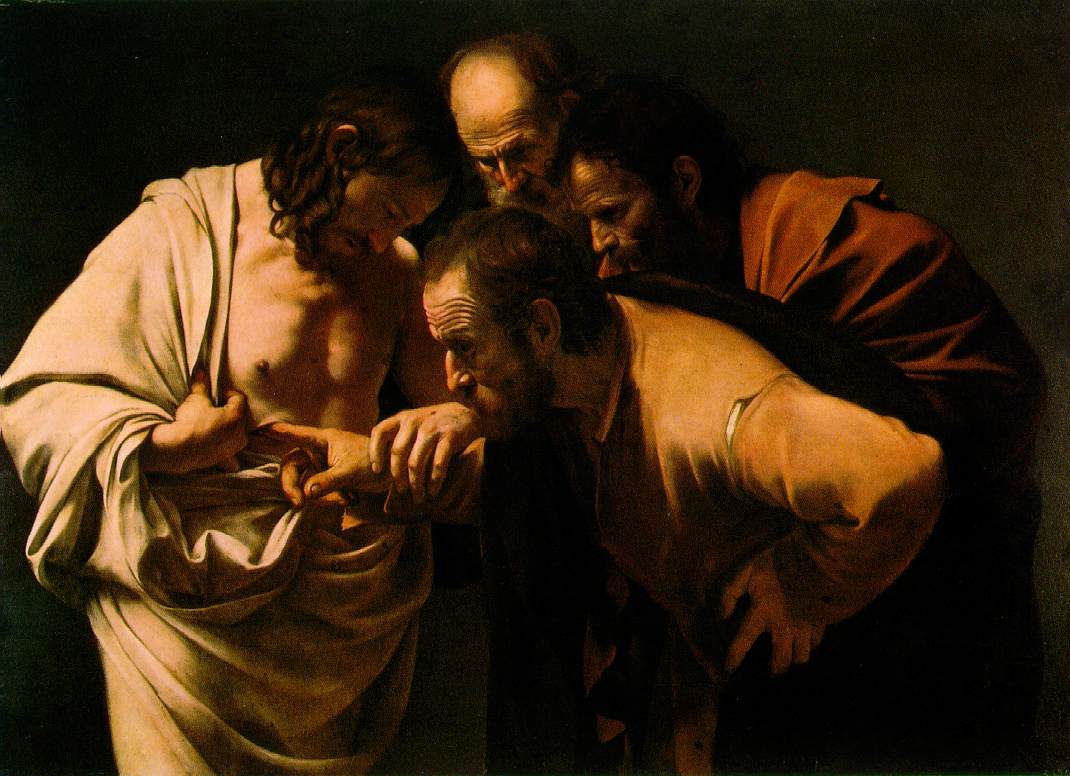
"The Incredulity of St. Thomas" by Caravaggio from Ibiblio
It made sense last week in New Orleans during our visit one afternoon that he would want to talk about the last letter his son Malcolm had written to him. Malcolm had died last March at the age of twenty-four, and Michael and his wife Maureen just observed the first anniversary of their son’s death.
Michael did not have a copy of Malcolm’s short letter in front of him, but he had its contents memorized. As though the letter were lying flat on the table in front of him, Michael moved his finger through line after invisible line of what his son had written. It was a simple message of the love Malcolm had had for his parents and his family.
When Michael came to the P.S. of the letter, he had to stop. How much the words he wanted to read meant to Michael was obvious from the emotion that prevented him at first from continuing. How much the words meant to him was obvious from the determination with which Michael finally managed through tears to recite his son’s last words.
It had been two years since the last visit that Michael and I had arranged, another afternoon in New Orleans with just the two of us at first, joined later by Maureen, ultimately all of us at the family dinner table with Malcolm. There was no way Michael and I could have had a subsequent visit without talking about Malcolm. There might have been if Michael were another sort of man, another sort of father, another sort of friend.
Because Michael was the sort of friend he was, though, I ventured in time to talk about issues that had brought me into therapy during those two years we had not seen one another. What I told him of the circumstances of my own growing up revealed a part of my story that he had never guessed. What I told him of the losses of the past several years was met by understanding attention.
We both of us offered at times in the afternoon’s conversation to defer to the comfort of the other and move on to other topics. Neither of us really wanted to, however.
The fact we had neither of us ever foreseen sitting across from a friend of thirty years and talking about these kinds of loss did not seem a reason to avoid them as subjects of conversation. On the contrary, it seemed the reason to move into them, to let the tears come when they would, to ask the questions of one another that occurred to one or the other of us as our two hours together passed.
Near the close of our visit, Michael recalled the walk into Carlsbad Caverns that he and I had made together on a vacation in our twenties. He mentioned the way I had listened to him for over an hour as he spoke about the poet Gerard Manley Hopkins during our descent into the caverns. He was finding a cue in our common past to express his gratitude to have someone there this past week in New Orleans listening to what he wanted to say.
At the start of this Second Week of Easter, the Gospel narrative of Doubting Thomas was read in churches throughout the world. Today it is my turn to express gratitude for the trust with which someone offered to let me touch his wounds and to come to believe afresh that we are none of us alone.
"The Incredulity of St. Thomas" by Caravaggio from Ibiblio
Subscribe to:
Posts (Atom)