Two principal dancers stood before an after-show audience gathered in the lobby of the Boston Opera House. A young man and a young woman, exhausted from over two hours’ dancing in Eugene Onegin, did their professional best and from the steps of the grand staircase looked into the upturned faces of their fans. The dancers tried to do what they had agreed to do, to speak about their understanding of the ballet in which they had just performed so gloriously. One dancer pulled a white pullover closer around her; the other stood at ease in his jeans, hands joined behind his back.
From time to time in the next fifteen minutes, the ballerina put her hand on her chest, looked up into the air above her and said haltingly, “I'm sorry. I'm just emptied right now.” It was an apology, a plea for our understanding of what she had poured out for us through her dance.
In two different scenes in the ballet, each of these principals tears a letter into pieces. In each case we understand what the letter had said, what it had offered of the heart, of the world in which someone smitten lives. In each case the returned letter is at first refused; the writer of the letter will not touch the letter even when it is thrust before them. The unwilling recipient must then shred the letter before the face of its writer if a clear refusal is to be understood.
Love in 1820s Russia was not easy.
The journalist interviewing the two dancers asked about the significance of love letters. Do actual letters, she asked the dancers, have power in them that can be matched these days by email or text messages?
The young man thought not; he confessed, however, with a smile that he had never written a love letter.
At greater length the ballerina replied that the communication of love in a written letter, a hand-written letter, is flowing from the heart through the arm into the hand that writes it. The material object, the very paper on which the message is written, is soaked in the love of the person who has written it. Nothing similar, she thought, could happen in an email, a text message or a tweet.
The audience laughed, smiled, nodded, agreed; there was nothing we would not do for this ballerina at the end of the evening.
Amid half-regretful applause, we allowed ourselves ready. We would head out. The evening was over. If the two dancers were exiting by a different door from those by which we issued onto a cold February sidewalk, the dancers likely checked their phones as automatically as we did.
We made our ways into our histories. All of us.
Which one of us had ever torn up a love letter?
How many of us would get to write one again?

Monday, February 29, 2016

Monday, February 8, 2016
What This Lent Can Be About
Last summer I stayed in a monastery guest house for three days. There was the welcome chance to hear chant sung in Latin and French and to walk the québécois countryside.
One of the places I frequented between chapel services and meals in the guest-house dining room was the gift shop. The shelves of the gift shop were lined with honeys and jams and chocolates and cider. Refrigerator cases displayed cheeses in rounds and wedges. Attention was obviously paid to expiration dates, and stock was kept fresh and fresh-looking. Over the three days I made thoughtful decisions, choosing items that matched my buying history in other settings. My purchases reflected me and what I regularly like to serve or give as gifts.
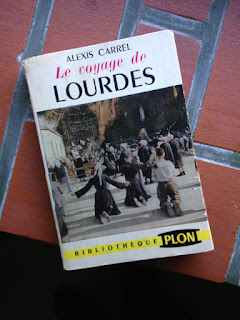
The shelves of the guest-house library offered a different kind of challenge, and what I took back to my room the first night was a soft-cover volume in French. Part of the lure of the book was that it was worn enough to assure me that it had attracted other readers since its printing in the early 1950s. The cover photograph showing pilgrims at Lourdes, their hands raised in prayer, had faded over the years; the pages were yellowed.
Familiar though I was with the story of the Marian apparitions, I was hardly what one would call a devotee of the literature of healings and testimonies. The French prose of the opening pages was clear, however, written by a medical doctor accompanying one of the standard pilgrimages into the Pyrenees in the early 1900s; the tone of the narrative was intelligent.
I decided to spend time that first night of retreat with the young doctor as he moved through the cars of the train on its way into the mountains. I read how he examined one of the gravest cases, a young woman with tuberculosis; its progress left her in increasing pain and discomfort through the night of travel. The doctor described a discoloration under her fingernails that was a sign of the irreversible onset of the death agony. Giving her morphine, he urged her to consider returning to Paris, but she was strong-willed. She intended going on with the other pilgrims and praying with them the next day at the famous grotto in Lourdes.
I was reading a narrative that the doctor had kept from publication all his life. Other writings of his would get into print, but not this tale of a healing that the doctor had witnessed and could hardly credit at first. A long skepticism, one of the characteristics that had qualified him in a special way for his work on the pilgrim journeys, drove him to spend a solitary night before the grotto where apparitions of Our Lady were said to have occurred. Be real, he begged Mary during his night in prayer, be more than a beautiful legacy of art and poetry. Make the healing of the young woman with tuberculosis a real one and a complete one.
Why does this memory from the summer visit to a monastery come to me at the approach of Lent? In earlier years I have made thoughtful decisions about how to observe this season healthily and sanely. What might this Lent be about? A hunger for what?
A life more real at times than anything I might write about it.
An experience safely beyond what can get me raising the camera, almost involuntarily taking aim as though to ensure that no one can take issue or cast doubts or dismiss what is unfolding before me and around me.
A conviction about how I might live beyond the writing and beyond the camera and beyond the setting down and serving up my story like a gift of honey, like a wedge of cheese.
Is there something ready to come into my life that I can just look up and see? Can I just look up and even not yet see it and still know how all right my life has been?
One of the places I frequented between chapel services and meals in the guest-house dining room was the gift shop. The shelves of the gift shop were lined with honeys and jams and chocolates and cider. Refrigerator cases displayed cheeses in rounds and wedges. Attention was obviously paid to expiration dates, and stock was kept fresh and fresh-looking. Over the three days I made thoughtful decisions, choosing items that matched my buying history in other settings. My purchases reflected me and what I regularly like to serve or give as gifts.

Familiar though I was with the story of the Marian apparitions, I was hardly what one would call a devotee of the literature of healings and testimonies. The French prose of the opening pages was clear, however, written by a medical doctor accompanying one of the standard pilgrimages into the Pyrenees in the early 1900s; the tone of the narrative was intelligent.
I decided to spend time that first night of retreat with the young doctor as he moved through the cars of the train on its way into the mountains. I read how he examined one of the gravest cases, a young woman with tuberculosis; its progress left her in increasing pain and discomfort through the night of travel. The doctor described a discoloration under her fingernails that was a sign of the irreversible onset of the death agony. Giving her morphine, he urged her to consider returning to Paris, but she was strong-willed. She intended going on with the other pilgrims and praying with them the next day at the famous grotto in Lourdes.
I was reading a narrative that the doctor had kept from publication all his life. Other writings of his would get into print, but not this tale of a healing that the doctor had witnessed and could hardly credit at first. A long skepticism, one of the characteristics that had qualified him in a special way for his work on the pilgrim journeys, drove him to spend a solitary night before the grotto where apparitions of Our Lady were said to have occurred. Be real, he begged Mary during his night in prayer, be more than a beautiful legacy of art and poetry. Make the healing of the young woman with tuberculosis a real one and a complete one.
Why does this memory from the summer visit to a monastery come to me at the approach of Lent? In earlier years I have made thoughtful decisions about how to observe this season healthily and sanely. What might this Lent be about? A hunger for what?
A life more real at times than anything I might write about it.
An experience safely beyond what can get me raising the camera, almost involuntarily taking aim as though to ensure that no one can take issue or cast doubts or dismiss what is unfolding before me and around me.
A conviction about how I might live beyond the writing and beyond the camera and beyond the setting down and serving up my story like a gift of honey, like a wedge of cheese.
Is there something ready to come into my life that I can just look up and see? Can I just look up and even not yet see it and still know how all right my life has been?
Wednesday, January 20, 2016
The Space for a Name
For the kind of writing I like to do, I need to hold my breath. No one automatically sounds like this. No one in the midst of a day, in the midst of the night, in the midst of a life sounds like this.
When I go for a while without writing – and the evidence is clear in something like a blog – I begin my questions. Why not? Why not write? What else is there to occupy me these days?
When I do the kind of writing I like to do, I tend to look up. I tend to look for the surface but from below. And for that immersion I need to do something like hold my breath.
 I can't need my breath for a length of time if I am going to go into that immersion. I can't need that breath for laughing. I can't need that breath for gasping with sudden wonder. I can’t need that breath for savoring the strong tea I love. I can't need that breath for singing hymns and carols. I can't need that breath for responding to the kind of attention for which a hunger develops over time in me.
The thing that someone says. The look that someone gives. The touch that someone allows. The time that someone lavishes over things that I, too, love.
I need my breath for those things. I cannot always with calm and deliberation immerse myself, lower myself below the surface, look up at light that is just on the other side of the surface. I sometimes lose the practice of holding my breath and feeling the words, yes, feeling the words arise on their own.
And if the words do not arise on their own, why write? Why hold my breath?
Why not trust, and this is an act of trust, that something is afoot when I do not write, something is happening, something full of light, just above the surface, worthy – in time— of words.
In time I will hold my breath again. The words will arise. The space where a name should go will get a little clearer.
When I go for a while without writing – and the evidence is clear in something like a blog – I begin my questions. Why not? Why not write? What else is there to occupy me these days?
When I do the kind of writing I like to do, I tend to look up. I tend to look for the surface but from below. And for that immersion I need to do something like hold my breath.

The thing that someone says. The look that someone gives. The touch that someone allows. The time that someone lavishes over things that I, too, love.
I need my breath for those things. I cannot always with calm and deliberation immerse myself, lower myself below the surface, look up at light that is just on the other side of the surface. I sometimes lose the practice of holding my breath and feeling the words, yes, feeling the words arise on their own.
And if the words do not arise on their own, why write? Why hold my breath?
Why not trust, and this is an act of trust, that something is afoot when I do not write, something is happening, something full of light, just above the surface, worthy – in time— of words.
In time I will hold my breath again. The words will arise. The space where a name should go will get a little clearer.
Sunday, November 22, 2015
Church-going
No, it wasn't the building.
It wasn't the flowers arranged and opening before the altar table. It wasn't the blue wall behind the Virgin's statue in a niche high up above the sanctuary. It wasn't the gesture, one hand raised with fingers gently curled, by which Christ, his mother and the saints communicate some message, some authority out of mosaic and stained glass and marble statue.
It wasn't the sound swelling out of organ pipes. It wasn't the procession, cross first, candles flanking, book of readings held aloft. It wasn't the words of the hymn, my voice joined by other voices from fellow singers I could not see, all of us bent over songbooks, eyes moving over the musical notations, dipping down into words separated into syllables, all of us guided by some familiarity gained by months and years of Sundays.
It probably wasn't even the celebrant, homilist, pastor, presider.
The injury, though, needed a building as tall as this, a ritual as old as this, a city congregation just this various and motley, or the injury threatened to pull me down, back into a pattern too old to recognize before it had started its weighing in, weighing down, almost blinding, nearly depleting.
I am at an age, though, and a stage of inner work to be able to rouse myself at the signs, the insinuating words of judgment, the ache of a deprivation so close to the bone that it sometimes passes for me.
Without all this building and ritual and congregation, where would I be? Without the host pressed into my hands each week by communion ministers whose faces I recognize, whose names I know, whose presence before me depends on nothing I ever do, where would I be?
I emerge, though, each Sunday face wet with tears. I am able to claim all this, own all this, move toward another week, await another Sunday.
It wasn't the flowers arranged and opening before the altar table. It wasn't the blue wall behind the Virgin's statue in a niche high up above the sanctuary. It wasn't the gesture, one hand raised with fingers gently curled, by which Christ, his mother and the saints communicate some message, some authority out of mosaic and stained glass and marble statue.
It wasn't the sound swelling out of organ pipes. It wasn't the procession, cross first, candles flanking, book of readings held aloft. It wasn't the words of the hymn, my voice joined by other voices from fellow singers I could not see, all of us bent over songbooks, eyes moving over the musical notations, dipping down into words separated into syllables, all of us guided by some familiarity gained by months and years of Sundays.
It probably wasn't even the celebrant, homilist, pastor, presider.
The injury, though, needed a building as tall as this, a ritual as old as this, a city congregation just this various and motley, or the injury threatened to pull me down, back into a pattern too old to recognize before it had started its weighing in, weighing down, almost blinding, nearly depleting.
I am at an age, though, and a stage of inner work to be able to rouse myself at the signs, the insinuating words of judgment, the ache of a deprivation so close to the bone that it sometimes passes for me.
Without all this building and ritual and congregation, where would I be? Without the host pressed into my hands each week by communion ministers whose faces I recognize, whose names I know, whose presence before me depends on nothing I ever do, where would I be?
I emerge, though, each Sunday face wet with tears. I am able to claim all this, own all this, move toward another week, await another Sunday.
Friday, November 20, 2015
Walking Authors Ridge

Much that is familiar inevitably rises up around me. Much that is familiar rises up within me.
It is a storied landscape into which I drive, even if the goal is a restaurant bar where a friend from high school will stand me a beer in early celebration of my birthday. He and I determined long ago that Concord was close to the midpoint for us journeying from our homes. The ease of finding Concord and finding parking and finding places to walk and talk and eat can partially account for its appeal.
As well, it suits our age. We are among those growing up in the Sixties for whom there was no holier name than Thoreau and no prober of the troubled psyche better than the grim Hawthorne.
Rob and I retreat to Concord as to a place where ideas and the lives lived in accordance with them have enjoyed a venerable arena.

We are men in our middle sixties, over-educated and literary and religious in a Walker Percy kind of way.
Putting down my brown ale last Sunday afternoon, I looked up from a bar plate of monkfish and asparagus as Rob finished a surprising admission. Against the increasingly solitary thing that his own life has become as children move away, he commented with admiration on how I have repeatedly put myself out there.
However I remember recent birthdays – flowers that one suitor sent me, the driftwood fire that a South Shore gentleman had built on the beach, a gray plaid flannel shirt from a Mainer loyal to LL Bean – Rob was serious in his respect. He did not suspect that I could look over his shoulder and see where I had sat with still another friend just a day or two earlier, immersed in nuanced confidences and a familiar wonder.

I made my way, recognizing as I did a long-ago longing. I think I had always hoped to be just such a solitary man at this time of day. I think I had always dreamed of walking Authors Ridge at this time in my life.
Wednesday, November 4, 2015
Pierre Charles and Belgium in the 1920s

Early in the morning between winter and spring, when the grass is frosty, when there is no scent and no sound but a heavy white stillness, and yet you know the blackbird may speak at any moment, a sharp sweet waterfall of sound fall down, and the earth wake – on such a morning the milkman whistles “Auprès ma blonde” as he drives down the little alley behind the houses on Boulevard Léopold.
The poet at the narrative heart of the novel is based on a mentor of Sarton’s, someone who taught her in the mid 1920’s when Sarton was twelve years old and a student at the Institut Belge de Culture Française in a suburb outside Brussels.
When a writer knows where she is going, when she uses sentence structures that show an awareness of the complexity of situations, when she employs words that are not the simple or obvious ones – doing so in the service of something that is not simple or obvious – I am snared. I follow her.
Many readers of May Sarton do. We become a following. We are linked by a feeling of shared allegiance to that solitary life and the words that got written when no one else was around. In a way, we own ourselves heirs of her quiet hours.
Recently in my own quiet hours I have turned to a Belgian author whose books would have been available in specialized bookstores in Brussels in the mid-1920s. Pierre Charles, S.J., and his writings are familiar from my seminary days. I do not imagine either the twelve-year-old Sarton or her poet/teacher Marie Closset being drawn to a book of meditations by a young professor of theology who then lived an hour away in the university town of Louvain.

In time La Prière de toutes les heures (1923) would be translated into nine languages. The custom of collecting a series of short meditations – each three or four pages long – and publishing them was not new when Pierre Charles was ordained a priest in 1910. A number of such collections would have been available in the seminary library in Tronchiennes where Pierre Charles had completed his two-year novitiate in 1901 and where he had spent a final year of spiritual formation after ordination.
Perhaps the skill of creatively inviting a listener into a Gospel text was one that Pierre Charles early recognized as his own. An individual making a retreat led by the young priest or attending a Sunday Mass where he had preached may have asked for copies of his words. What evidently had the power of helping people think about their lives might have seemed worth sharing with a larger audience.
When a writer knows where he is going, when he uses sentence structures that show an awareness of the complexity of situations, when he employs words that are not the simple or obvious ones – doing so in the service of something that is not simple or obvious – I am snared. I follow him.
I do not know that many other readers do. A hundred years after their publication, I do not realistically expect that there is a following for his writings. I look at old black-and-white postcards of the seminary at Tronchiennes and imagine a young Pierre Charles along its paths and in its chapels, wondering to himself what his life will be like, wondering what the rest of the twentieth century will be like. My allegiance to that solitary life and the words that got written when no one else was around may have to remain itself a fairly solitary thing.
I do not regret owning myself the heir of another man’s quiet hours.

Saturday, October 31, 2015
Georgics: The Landscape of Intellectual Adventure
It is good to record how an intellectual adventure began, how the seeds were sown.
It was in someone else’s blog in early August 2005 that I came across lines from Boston poet David Ferry’s newly published translation of Virgil’s Georgics.
O greatly fortunate farmers, if only they knew
How lucky they are! Far from the battlefield,
Earth brings forth from herself in ample justice
The simple means of life, simply enjoyed…
“The simple means of life, simply enjoyed” – an apt phrase by Ferry, poetry in English no matter how the original Latin might read. My impression of what had previously seemed a minor work by the author of the Aeneid was on the verge of deepening. I felt lured by the peaceful mood created around Virgil’s ideal of the farmer:
His sleep at night is easy, his life knows nothing
About deceit or trickery, and his life
Is rich in many things: tranquillity
Of the broad fields, of grottoes, and of lakes,
Of cattle lowing while in the shade of a tree
The herdsman peacefully dozes…
Reading further in the passage from Book II of the Georgics, I got a glimpse into a kind of writing that I had not associated before with the Rome of the Caesars. No matter the pantheon in which Virgil situated himself as a poet, I felt invited into the landscape of his family, into its weathers and shadows, into stars and waves.
Why is it that the sun in winter hurries
To plunge itself into the sea and why
Is the winter night so slow to come to an end?
But if the blood around my heart's too cold
To gain me access to such mighty knowledge,
Then may I find delight in the rural fields
And the little brooks that make their way through valleys,
And in obscurity love the woods and rivers.
I long for such places…
I felt the urge to read more – and maybe not only this most recent translation. I wondered what it would be like to spend time with the Latin of Virgil again. I had last studied Latin in an organized way in high school, eventually translating substantial sections of the Aeneid as a student in Latin IV. Taking advantage forty years later of online Latin texts of the Georgics, I began to explore anew the language of this strangely paced poetry.
My curiosity led me to other websites where I began to explore what other people were thinking of the Georgics. I located recommendations for commentaries and surveys that throw light on the mythological and agricultural references teeming in Virgil’s lines. With the help of Google, I tasted the flavor of the international community of scholars dealing with the Georgiques, the Georgiche, or the Georgica.
In discovering something of the range and history of English translations of the poem, I became fascinated by the variety of situations in which people over the years have decided to sit down with the ancient text and attempt a new rendering. Assigned by my high school Latin teacher to read an English translation of the Aeneid, I had responded to the pull of this epic narrative as rendered by then British poet laureate C. Day Lewis. Decades later I was to learn that Lewis had also translated the Georgics.
An impulse purchase of a used copy of the Lewis translation from a book dealer in Tennessee brought the 1947 hardcover into my hands, still bookmarked with a yellowed Christmas gift-tag labeled “Rindges from Chapins.”
Something happened then. I began to sense myself sitting in the company of other readers of the Georgics. None of them were people I would ever likely meet, but all of us had been summoned on an intellectual adventure, invited into a landscape, its weathers and shadows, its stars and waves.
It was in someone else’s blog in early August 2005 that I came across lines from Boston poet David Ferry’s newly published translation of Virgil’s Georgics.
O greatly fortunate farmers, if only they knew
How lucky they are! Far from the battlefield,
Earth brings forth from herself in ample justice
The simple means of life, simply enjoyed…
“The simple means of life, simply enjoyed” – an apt phrase by Ferry, poetry in English no matter how the original Latin might read. My impression of what had previously seemed a minor work by the author of the Aeneid was on the verge of deepening. I felt lured by the peaceful mood created around Virgil’s ideal of the farmer:
His sleep at night is easy, his life knows nothing
About deceit or trickery, and his life
Is rich in many things: tranquillity
Of the broad fields, of grottoes, and of lakes,
Of cattle lowing while in the shade of a tree
The herdsman peacefully dozes…
Reading further in the passage from Book II of the Georgics, I got a glimpse into a kind of writing that I had not associated before with the Rome of the Caesars. No matter the pantheon in which Virgil situated himself as a poet, I felt invited into the landscape of his family, into its weathers and shadows, into stars and waves.
Why is it that the sun in winter hurries
To plunge itself into the sea and why
Is the winter night so slow to come to an end?
But if the blood around my heart's too cold
To gain me access to such mighty knowledge,
Then may I find delight in the rural fields
And the little brooks that make their way through valleys,
And in obscurity love the woods and rivers.
I long for such places…
I felt the urge to read more – and maybe not only this most recent translation. I wondered what it would be like to spend time with the Latin of Virgil again. I had last studied Latin in an organized way in high school, eventually translating substantial sections of the Aeneid as a student in Latin IV. Taking advantage forty years later of online Latin texts of the Georgics, I began to explore anew the language of this strangely paced poetry.
My curiosity led me to other websites where I began to explore what other people were thinking of the Georgics. I located recommendations for commentaries and surveys that throw light on the mythological and agricultural references teeming in Virgil’s lines. With the help of Google, I tasted the flavor of the international community of scholars dealing with the Georgiques, the Georgiche, or the Georgica.
In discovering something of the range and history of English translations of the poem, I became fascinated by the variety of situations in which people over the years have decided to sit down with the ancient text and attempt a new rendering. Assigned by my high school Latin teacher to read an English translation of the Aeneid, I had responded to the pull of this epic narrative as rendered by then British poet laureate C. Day Lewis. Decades later I was to learn that Lewis had also translated the Georgics.
An impulse purchase of a used copy of the Lewis translation from a book dealer in Tennessee brought the 1947 hardcover into my hands, still bookmarked with a yellowed Christmas gift-tag labeled “Rindges from Chapins.”
Something happened then. I began to sense myself sitting in the company of other readers of the Georgics. None of them were people I would ever likely meet, but all of us had been summoned on an intellectual adventure, invited into a landscape, its weathers and shadows, its stars and waves.
Tuesday, October 20, 2015
The Past Ten Years
New Orleans was noticeably absent from the textbooks I used in my classes at St. Agnes Parochial School in the late 1950’s.
Illustrations did not show red beans and rice on the kitchen table on Monday evenings. Nothing like the drive along the River Road on Christmas night found its way into our readers. Parents crossing themselves as my parents did when we drove past a Catholic church did not head the families about whom we read our first simple paragraphs. In word problems the pies that had to be divided into quarters or eighths were never pecan pies.
I was not surprised that New Orleans did not matter in the books we read.
I simply concluded that New Orleans did not matter.
I was not surprised at the readiness with which I believed that I did not matter either.
Or if I did, it was because I had raised my hand in class and had given the right answer. It was because I had appeared on summer mornings at St. Agnes and served as acolyte at an early Mass. It was because my academic prowess had given my parents a way to cut a figure at parent-teacher meetings at school.
My salvation was that I did not know on an easy, conscious level that I did not matter. A painful clarity flickered, however, when I looked for a place at a large family Christmas or searched out a bus seat on a school activity. No one at home seemed to know how or when to say, “John, let me tell you what I think is happening in your life.” No one confided, “You know, it’s scary sometimes how much you are like your dad or your mom.” But then whose job was that? I may not have felt worth the effort it would take someone to understand me, and I may have communicated as much.
I was frankly not surprised that I did not matter. I understood, though, that writers did.
Early on I practiced replicating the kinds of sentences and paragraphs that I found on page after page in library books. I managed to get read and I got to matter when articles I had written appeared in student publications. Friends from my high school years still remember particular editorials that I submitted. I had gotten to try out writing about life, even my life, and sounding like I understood it.
Writing became something about which I was confident. My professional life for a number of years involved the teaching of writing. In my late 40’s I began to work on a memoir of sorts. No one to whom I showed it suggested, “John, let me tell you what I think was actually happening in your life at that point.” No one confided, “You know, it’s scary sometimes how much you sound like your brother or your teacher in the ways you express yourself.” But then whose job was that? I may well have communicated that it did not matter.
By 2005 I was writing my first blog. I had found inspiration in a French newspaper article about the phenomenon of elder bloggers. Within an online world dominated by much younger commentators and critics, older people intent on finding an audience for what they understood of their lives and their world were creating blogs that actually got read. Those mature writers and photographers were telling stories that most people had not thought would be told. And all for free!
Please Forward: How Blogging Reconnected New Orleans after Katrina appeared in August 2015, the tenth anniversary of the hurricane. The title takes me back to that scary month and the relentless flooding of the landscape of my family, the homes and streetcars and oak trees and above-ground tombs where my memories had once seemed to find safe lodging. Wherever I had chosen to live my adult, professional life, I always thought it possible to travel back home and in time bring a wisdom to bear. With the perspective of age, I could finally counter the stubborn judgments I had leveled against myself as a child and as a young man.
I recall the online reading I did through that fall of 2005 as the damage sustained by my home town kept unrolling. Bloggers told an unsteady story of ways to live that might not return. New Orleans was gone, I began to conclude in the shock of the images.
A fearful suspicion kept trying to surface the truth that I was gone too.
With the kind of sorrow that emerged and the signs of sadness that stayed, I suspected what I needed to do. I might just have to pay someone to be the audience for what I understood of my life and my world. Facing the facts, I located a professional whose job it would be – one day a week – to listen and then maybe to say, “John, let me tell you what I think was actually happening in your life at that point.” I engaged someone to whom I could confide, “You know, it’s scary sometimes how much I sound like my father or my mother.”
I began to glimpse the ways I had learned over the years to communicate that it did not matter. I got help seeing that it might be time for that me to be gone.
I do not live now as I did ten years ago. After steps I was helpless not to take, along paths I was determined I would go, with the conviction that I would hear what I sounded like, I say with some incredulity that things are different.
And I keep learning.
I had not thought I could matter just this way.
Illustrations did not show red beans and rice on the kitchen table on Monday evenings. Nothing like the drive along the River Road on Christmas night found its way into our readers. Parents crossing themselves as my parents did when we drove past a Catholic church did not head the families about whom we read our first simple paragraphs. In word problems the pies that had to be divided into quarters or eighths were never pecan pies.
I was not surprised that New Orleans did not matter in the books we read.
I simply concluded that New Orleans did not matter.
I was not surprised at the readiness with which I believed that I did not matter either.
Or if I did, it was because I had raised my hand in class and had given the right answer. It was because I had appeared on summer mornings at St. Agnes and served as acolyte at an early Mass. It was because my academic prowess had given my parents a way to cut a figure at parent-teacher meetings at school.
My salvation was that I did not know on an easy, conscious level that I did not matter. A painful clarity flickered, however, when I looked for a place at a large family Christmas or searched out a bus seat on a school activity. No one at home seemed to know how or when to say, “John, let me tell you what I think is happening in your life.” No one confided, “You know, it’s scary sometimes how much you are like your dad or your mom.” But then whose job was that? I may not have felt worth the effort it would take someone to understand me, and I may have communicated as much.
I was frankly not surprised that I did not matter. I understood, though, that writers did.
Early on I practiced replicating the kinds of sentences and paragraphs that I found on page after page in library books. I managed to get read and I got to matter when articles I had written appeared in student publications. Friends from my high school years still remember particular editorials that I submitted. I had gotten to try out writing about life, even my life, and sounding like I understood it.
Writing became something about which I was confident. My professional life for a number of years involved the teaching of writing. In my late 40’s I began to work on a memoir of sorts. No one to whom I showed it suggested, “John, let me tell you what I think was actually happening in your life at that point.” No one confided, “You know, it’s scary sometimes how much you sound like your brother or your teacher in the ways you express yourself.” But then whose job was that? I may well have communicated that it did not matter.
By 2005 I was writing my first blog. I had found inspiration in a French newspaper article about the phenomenon of elder bloggers. Within an online world dominated by much younger commentators and critics, older people intent on finding an audience for what they understood of their lives and their world were creating blogs that actually got read. Those mature writers and photographers were telling stories that most people had not thought would be told. And all for free!
Please Forward: How Blogging Reconnected New Orleans after Katrina appeared in August 2015, the tenth anniversary of the hurricane. The title takes me back to that scary month and the relentless flooding of the landscape of my family, the homes and streetcars and oak trees and above-ground tombs where my memories had once seemed to find safe lodging. Wherever I had chosen to live my adult, professional life, I always thought it possible to travel back home and in time bring a wisdom to bear. With the perspective of age, I could finally counter the stubborn judgments I had leveled against myself as a child and as a young man.
I recall the online reading I did through that fall of 2005 as the damage sustained by my home town kept unrolling. Bloggers told an unsteady story of ways to live that might not return. New Orleans was gone, I began to conclude in the shock of the images.
A fearful suspicion kept trying to surface the truth that I was gone too.
With the kind of sorrow that emerged and the signs of sadness that stayed, I suspected what I needed to do. I might just have to pay someone to be the audience for what I understood of my life and my world. Facing the facts, I located a professional whose job it would be – one day a week – to listen and then maybe to say, “John, let me tell you what I think was actually happening in your life at that point.” I engaged someone to whom I could confide, “You know, it’s scary sometimes how much I sound like my father or my mother.”
I began to glimpse the ways I had learned over the years to communicate that it did not matter. I got help seeing that it might be time for that me to be gone.
I do not live now as I did ten years ago. After steps I was helpless not to take, along paths I was determined I would go, with the conviction that I would hear what I sounded like, I say with some incredulity that things are different.
And I keep learning.
I had not thought I could matter just this way.
Thursday, September 17, 2015
Morning Walks
Since the start of this past summer I have opened my apartment door before 6 o’clock most mornings. The walk I undertake through my neighborhood rarely lasts longer than forty minutes, and I am generally alone as I move down block after quiet block. The sky lightens.
I am walking with a goal – avoiding a medication with which my doctor threatened me back in March if I did not bring my blood sugar levels down. The past half year has had a focus that affects what I eat and how much and how regularly and what I do in the way of exercise.
By this past May I had lost enough weight to convince my doctor, my work colleagues and myself that something had changed in my life.
As I began my regimen of walking this summer, I recovered energy. I began to find living easier when there was less me to carry around.
Easier to put one foot in front of another down neighborhood streets. Harder to escape a sense of the many directions my life has become accustomed to moving at other times.
How do I make sense out of a basket of old dairies and journals beside an overstuffed chair in my apartment? In the same room a laptop sits open on a collapsible table, and the kind of writing that populates this blog has often gotten done there but never on the iPad that lies on the leather couch in another room. There is a style of online exploration that has become associated with the iPad and even the iPhone, but I have not yet managed to read a book straight through by means of either device. Real books form stacks on what would once have been called a coffee table in front of my leather couch. When I am seated there and drink my morning coffee, though, I rest my mug on a side table on which stand photographs in frames. Other photographs line the mantelpiece. Guests regularly sit in another armchair near the couch, and we share the coasters where I rested my coffee earlier in the day. At times a cat perches and watches nearby or circles and sleeps on any number of available surfaces.
Can any of this become simpler, I ask myself? Forget about the television and the CD player and the portable record player that I recently recovered from storage to play the vinyl albums I found.
Sunday morning Mass? A symphony subscription for the coming year?
And then suppose I were to fall in love?
In how many directions could my mind move then during a forty-minute walk at 6 in the morning!
I am walking with a goal – avoiding a medication with which my doctor threatened me back in March if I did not bring my blood sugar levels down. The past half year has had a focus that affects what I eat and how much and how regularly and what I do in the way of exercise.
By this past May I had lost enough weight to convince my doctor, my work colleagues and myself that something had changed in my life.
As I began my regimen of walking this summer, I recovered energy. I began to find living easier when there was less me to carry around.
Easier to put one foot in front of another down neighborhood streets. Harder to escape a sense of the many directions my life has become accustomed to moving at other times.
How do I make sense out of a basket of old dairies and journals beside an overstuffed chair in my apartment? In the same room a laptop sits open on a collapsible table, and the kind of writing that populates this blog has often gotten done there but never on the iPad that lies on the leather couch in another room. There is a style of online exploration that has become associated with the iPad and even the iPhone, but I have not yet managed to read a book straight through by means of either device. Real books form stacks on what would once have been called a coffee table in front of my leather couch. When I am seated there and drink my morning coffee, though, I rest my mug on a side table on which stand photographs in frames. Other photographs line the mantelpiece. Guests regularly sit in another armchair near the couch, and we share the coasters where I rested my coffee earlier in the day. At times a cat perches and watches nearby or circles and sleeps on any number of available surfaces.
Can any of this become simpler, I ask myself? Forget about the television and the CD player and the portable record player that I recently recovered from storage to play the vinyl albums I found.
Sunday morning Mass? A symphony subscription for the coming year?
And then suppose I were to fall in love?
In how many directions could my mind move then during a forty-minute walk at 6 in the morning!
Friday, August 14, 2015
Another Man's Library
I am primed to explore another man’s library. On four separate occasions this summer I have been in his house, sometimes left by myself in one of the rooms where his books stock multiple shelves, sometimes seated across from him, able to glimpse over his shoulder the titles in a bookcase.
I can joke, one man in his sixties talking to another man in his sixties, and threaten to abscond with a volume he will never miss once I am gone. He laughs, waves his hand at the shelves around him and across the room, and lets me know I am welcome to take anything.
I laugh with one part of my brain and surprise another part already planning my moves.
All scholarly insight and humor, we might be Alec Guinness in conversation with Ian McKellan, each eyeing the other behind a gentlemanly white beard.
As I write, I look over the books on some of my own shelves. I know why the books are where they are, why some stand and others lie stacked. To which of these many might he be drawn when he has visited me?
Will their interest for him be anything like the lure of his books for me? Will he reach for a familiar cover and enjoy watching pages open where last I read from them – a month ago, a year ago, two decades?
Will we both get to wonder what the other had been like then, at a time closer to the original publication of a particular book? When one of us read just that page, might he have been picking up a wedge of orange, sipping a cold beer, biting into a slice of dry toast?
Will we both get to wonder what the other had been like at an age when being older than fifty would have seemed to either of us an unlikely event in an unimaginable future?
But here we are.

I can joke, one man in his sixties talking to another man in his sixties, and threaten to abscond with a volume he will never miss once I am gone. He laughs, waves his hand at the shelves around him and across the room, and lets me know I am welcome to take anything.
I laugh with one part of my brain and surprise another part already planning my moves.
All scholarly insight and humor, we might be Alec Guinness in conversation with Ian McKellan, each eyeing the other behind a gentlemanly white beard.
As I write, I look over the books on some of my own shelves. I know why the books are where they are, why some stand and others lie stacked. To which of these many might he be drawn when he has visited me?
Will their interest for him be anything like the lure of his books for me? Will he reach for a familiar cover and enjoy watching pages open where last I read from them – a month ago, a year ago, two decades?
Will we both get to wonder what the other had been like then, at a time closer to the original publication of a particular book? When one of us read just that page, might he have been picking up a wedge of orange, sipping a cold beer, biting into a slice of dry toast?
Will we both get to wonder what the other had been like at an age when being older than fifty would have seemed to either of us an unlikely event in an unimaginable future?
But here we are.

Subscribe to:
Posts (Atom)