Sunday, April 13, 2014

Holy Week 2014

Imagine knowing you are going to do something clumsily if you try it and yet doing it anyway. What could this mean? Either the outcome does not particularly matter to you or the issue at the heart of any outcome is so important that you cannot not try.

I remember reading this passage by a spiritual writer who died in 1914: “Meditate on the Passion, no matter how unskilfully, how clumsily, virtue will come out from it to us, to heal and to strengthen.”

For a religious superior who returned so often to “right thinking about God” as key to an individual’s progress in prayer and the spiritual life, Mother Janet Erskine Stuart seemed to have taken an intellectual humility pill before writing what she did.

Was she up against fellow sisters who continually lamented their failure of imagination in meditating on the final days of Jesus? Were these women who despaired of matching in their personal prayer the stirring detail by which retreat directors had moved them to tears in their preaching about the sufferings of Jesus?

Mother Stuart would have understood what Pope Francis sent out on Twitter last week: “How beautiful it is to stand before the Crucifix, simply to be under the Lord's gaze, so full of love.”

For that matter, I understand it.

Raised – like the Pope – at a time when the Way of the Cross was a devotion that filled parish churches during Lent, I recall the language of the prayers attached to the fourteen scenes arranged along the walls of the church. Through that language I learned that my response to the sufferings of Jesus was something by which Jesus would be comforted. I learned, in other words, that a relationship already existed between this man of sufferings and myself and that the relationship mattered to him.

How does that relationship matter to me as a man in his early sixties?

I am looking for analogies, but I am not sure I will be entirely successful. I would have to understand things in my history better than I do to propose an analogy that will help my life with Jesus make sense in print.

It is Holy Week, however. I look forward to the services. I look forward to sitting with people who can meditate as clumsily as I.

Tuesday, April 1, 2014

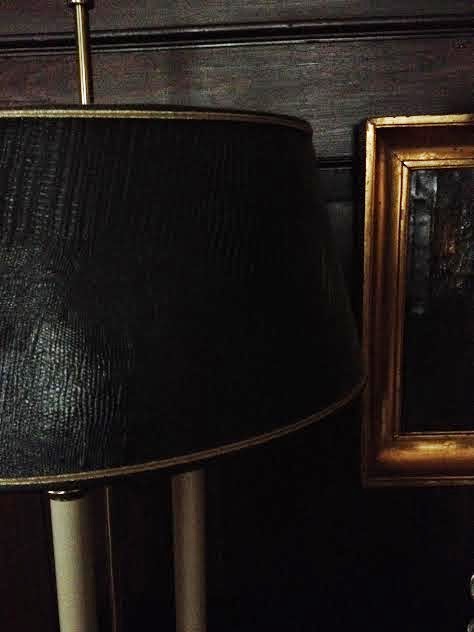
Lampshades


Look at them.

I do every time I visit my brother’s house in New Orleans. They are familiar from visits over the years, but last week I determined to make a record of some of the lampshades with which my brother in his decorating avoids the obvious and predictable – again and again


.


He knows how to invite attention. Because he has paid attention to detail, others pay attention. Because he has varied shape and size and color and edging and pattern and fabric, the lampshades in his home invite visitors to join in a certain playfulness. Watch where I go, they seem to say. Did you expect this, they almost ask.


Avoiding the obvious and predictable is something I strive to do when I write. In my experience, good writing is not the result of merely decorative words, however. It is not the unusual word for the sake of variety. More often than not, power of expression emerges when a writer with simplicity names what might not even have occurred to a reader as worthy of expression. Yes, the reader confesses, that is in fact how something in my world feels, how it looks, how it claims attention or sometimes even deflects it.

I suddenly notice. I almost involuntarily respond.

Tricked by the simplest of words, I recognize my world. I enter my own life.

My heart can feel called to attention.


Friday, March 14, 2014

Stunned by a Paragraph III


From Sussex by Esther Meynell


Each Sussex man or woman has one particular place or aspect in the county that above all others means Sussex. For me, in spite of a personal preference for the Eastern Downs, it is Chanctonbury, but Chanctonbury from far away. It was that blue view of Chanctonbury which gave me in childhood my first conscious feeling of the beauty of the visible world and the mystery of the invisible. Standing in the rough matted grass of a neglected field, looking westward, with the great line of the Downs sweeping towards a sunset sky where the headland of Chanctonbury floated like something of another world, beauty took hold of me, consciously and inescapably – the curious ache of it, and the troubling for the first time laid on the young resilient heart.


Thursday, March 13, 2014

New York Weekend

I am this side of a weekend in New York City.

The last time I visited the city was over three years ago. I was taking part in a conference in October 2010 on the Columbia campus. Travelling with colleagues, I managed some time on my own. One evening I attended a play written in rhyming couplets about a seventeenth-century French dramatist modeled on Moliere. I took the bus down from Columbia another day and strolled through the Neue Galerie on the Upper East Side.

A year earlier I had made a summer visit to a friend in the City. She and I sat gaping during one matinee performance of Mary Stuart while the heroine opened her arms to a rainstorm onstage. A poet and writer and librarian, my friend agreed to join me in journaling in the Reading Room of the New York Public Library; we took seats outside the library later and read to one another what we had written.

In the city on various occasions over the past three decades, I have strolled through Greenwich Village on numerous evenings with friends from New Jersey, attended Madama Butterfly at the Met for my fortieth birthday, went to Mass again and again at St Francis Xavier near Washington Square, and haunted the aisles of the Strand Book Store.

If I review New York memories at this point, it is to be able to step off the bus this Saturday morning and greet the friend meeting me and match his pace across town to lunch. No standing with a map, no squinting up at street signs. Just a weekend in the City. Just good conversation and unhurried eating. How did I get this lucky again?

Thursday, February 27, 2014

Eating Out

It happened again this week. Without seeking them out, I got to hear two people I know talking about a restaurant to which they had gone, each on a different day. It was restaurant review time. They had stopped near where I happened to be, and I do not know if they realized that I could hear them. I would not have given attention to what they were saying except I heard one of them saying something I had heard her say before in just this context: “I have to admit I was disappointed.”

Without seeing her, I could picture her at that moment. She would be leaning her head in and turning it slightly as though she were sharing something confidential.

What I knew was happening was that these two people had each ventured out to a restaurant and paid sixty or seventy dollars for a meal. Maybe more. As part of what they had paid for, a certain future frisson was their right. They could, if they wished, shudder with disappointment at their costly evening.

The bald truth is, they had been willing to incur significant expense for the chance to test the publicity, the advertising, the online reviews, the word of mouth among their acquaintances. There used to be times when I did the same thing, when I enjoyed the advantages of a two-income household. Was there resentment on my part this week hearing people with the freedom to be disappointed after a significant expense on what was actually a non-necessity? Was it that they had what I did not have, that they got to do what I could not?

No, that was not where my thinking was going. Not where my feeling was going as I overheard these two people. I frankly was thinking of all the perfectly satisfying meals I have had the good fortune to enjoy, meals that did not claim anything near sixty or seventy dollars. Some of them were meals ordered out in restaurants, but a whole lot more were prepared in my own kitchen and served at my dining room table.

Another little chink has been introduced into my ideas about how to spend money. What do I benefit from spending sums that I do not have to pay? Why do I and others venture so often to want more? What curiosity motivates us to look elsewhere when the satisfactory is so near and sometimes so easy?

How many priceless memories surround meals where the person across from us was the food we most needed?

Friday, February 14, 2014

Expectant Hearts

“Do you really believe that?”

If I mention at the lunch table something that I have seen on a television series the night before, no one asks me the question “Do you really believe that?” My colleagues do not suspect any extremes of technological naiveté on my part. I can profess admiration for Dr. John Watson’s loyalty in the newest PBS version of the Sherlock Holmes story, and lunch companions simply learn a little more about how I spend my evenings. They may glimpse something of my sympathies and values. They do not appear inclined to test my hold on reality.

“Do you really believe that?”

An inveterate reader of poetry is trained to imagine things. It is a tribute to the poet Mary Szybist that she can get me to picture the pigeons and doves she saw gathering one day in an ash tree in Bellagio, Italy. That is, if there really had been an ash tree. If there really had been birds that hopped from branch to branch one day while the poet watched them. Accepting the conventions of imaginative literature, I am eventually moved by a life truth that the writer, bereaved and far from home, manages to convey through just those images.

 “Do you really believe that?”

I grew up within a religious tradition with holy cards and a calendar of holy days. I grew up familiar with what a grotto might look like although I had never seen one. (Louisiana does not boast natural caves.) Very young, I learned the narrative about a grotto in southern France and a presence there to which an impoverished young girl had responded in the nineteenth century. I heard of subsequent pilgrim journeys and healings and hearts that were expectant as passengers looked out the windows of trains travelling into the French Pyrenees. When February 11 comes and goes each year, I get a reminder that it is human to be full of need and full of expectation.

I really believe that.

Friday, January 31, 2014

Learning about a Family

In October 2004 a dealer from Burlington, Vermont, placed a vintage photograph album for auction on Ebay with this description of the collection:

100 photographs in black and white showing a priest from his boyhood, through seminary and on to the work of the Catholic Church. The people are not identified, nor are the places. But there are two clues as to where this priest was from and where he may have served. On one page are two photo postcards (the only ones in the album). One is the interior of a church with this written at the bottom “Int de L’Eglise Napierville” and the other “Le Richelieu River” — both of these locales are in Quebec, Canada. The other is an envelope with pictures of the priest that is labeled “Lyndonville.” So it could be that this priest may have lived and/or served in both Quebec and Vermont. Perhaps someone remembers him?

Before I bid on the photo album, I tried to discover something about the seller. I wanted to know that she was reputable and that the album for sale was legitimately for sale. The description on Ebay made it seem an incredible find – something that no one would have parted with lightly or easily. I was reassured to find online a heartfelt tribute to the integrity of the seller; her name was on the business card attached to the wrapping in which she secured the album before sliding it into a mailing container to me.

Affecting my interactions with the album after the purchase was the commitment I had to removing none of the photographs from it. I had learned that there are sellers who remove individual photographs from a vintage album and offer them piece-meal for auction. On the other hand, there are sellers – and collectors – who insist on maintaining the integrity of the found object; the perspective here is that the photographs have a pleasure and a meaning when they are inspected individually and a still further message when they are seen in the context of the original collection.

As far as I could tell, the album that I had purchased was the creation of the original collector – either the priest himself or, I presumed, some member of his family. To scan certain photos without removing them from the album or damaging the pages to which they were attached, I untied the binding at one point (a kind of binding that was created to allow the addition or removal of album pages) and handled some of the first pages separately. I took care to return the pages in the order in which they had first appeared – not a strictly chronological one anywhere in the album, by the way.

In my time as the caretaker of the album, I followed clues in the names attached to certain items in the album. I began to entertain some possibilities about the identity and history of the priest at the center of this collection of pictures. For example, the village name of “Swanton” written in the margin of one picture of a religious procession exiting a church led me to an online picture of the same church on the website of the Catholic parish in Swanton, Vermont. On the margin of another photo someone had written “Romeo,” and the website of the Swanton Historical Society mentioned a Father Romeo Trahan as a speaker at an upcoming function. Typed on an envelope containing four or five small photos of a priest was the name “Père Trahan.” I was getting close, I thought.

I tried to figure out the best way to contact someone who might know the people in this album. Unfortunately, those ways always seemed a little too time-consuming to warrant interrupting the flow of work or the projects of a busy home life.

Meanwhile, the photos of the album began to have on me the same effect as the other vintage photos of nuns and priests and seminarians that I had been collecting at the time. My first goal with these old photographs had not been to sleuth around until I could identify the people and verify the circumstances of the event or the visit recorded in the picture. I kept being intrigued by these individuals who had lived in two worlds – the world of their birth family with all those powerful relationships of parents and siblings and cousins and the very distinctive world of their religious commitment. As a former student for the priesthood, I remember the opposing pull of those two worlds. I came in time to recognize in the pull of these photographs an invitation for me to explore and to respond to my own history and the history of my church.

Acting as the caretaker of the album with its photographs of this priest’s family was a role that I was ready to give up in 2006 when someone left this comment on Flickr next to one of the photographs I had posted there:

These photos are of my family members!! I recognize my grandfather, his father, and several aunts and uncles. How may I purchase these?

In a very short time this commenter convinced me that there was a real invitation for him and his family to renew their care of this album. Our exchange of emails gave me a reassuring sense of this man in his early forties:

My children and I are learning more about our family. Since both my parents are dead, I have spent many hours building the family history for my children. My father, Philip, has two brothers still living so I would very much like to show them these pictures too and ask them to help me identify further the people I do not recognize at first glance.

Within a few weeks I was placing the album in his hands. I wished him joy and pleasure in the care of these pictures of his family.

Four years later, I discovered this week, he himself would be dead of leukemia. I like to think the album is still there for his two daughters to grow in their sense of family.

When I was preparing the vintage album in 2006 to return it to the Trahan family, one photo had fallen out. Unattached to any of the pages of the album, it seemed a farewell gift from the priest, his sister and their father, who are pictured in the old photo. I have kept this photo for myself and have reproduced it at the head of this posting.

Tuesday, January 28, 2014

Perfect Spot, Rare Chance

I

My first venture as a homeowner twenty-five years ago took me into the ground level of what had been a private men’s club a century ago. The upstairs units had been developed as luxury condominiums. Period detail stopped, however, at the last step of the staircase leading to two basement units with open layouts and compact windows in deep wells high in the walls.

Access to the lawns surrounding the white two-storey Victorian building was easiest from those garden-level spaces. It took me no time to begin to carry a folding chair out onto the lawn on a Saturday morning, settle with a book and poise a tumbler of water in the thick grass alongside the chair. Nothing in the condo docs prohibited my use of the common area in this way, but the owners of the six other units never followed suit. Occasionally one of them would halt in her approach to the parking area and greet me: “You have found the perfect spot!”

II

From my office at work I can look out on landscaping by Frederick Law Olmsted. In saying that, I have given the reason most people would be interested in hearing about that edge of the property. From my office I nonetheless see and know how few people actually venture down the old walk. Our facilities staff keeps the area mowed and raked and trimmed and occasionally re-seeded. No one could fault us for not keeping the legacy up, but after a while enthusiastic appreciation fades amid the to and fro of everyday life.

One weekend last summer I suggested to a friend that we have a picnic in a quiet corner of the Olmsted-landscaped grounds. No one I know has taken advantage of the beautiful spot in just that way. We got to wend our way with the picnic hamper between century-old trees. Then we seated ourselves on a low ledge of masonry forming part of a trefoil design that gives definition to the sloping lawn. I remember looking up occasionally from bites into the sprouts and hummus wrap that I had made at home. What I got to survey about me that afternoon seemed a rare and lucky chance.

III

The hike was a cold one. There was no sign of the owners of the other car in the parking area of the Fenton-Ruby Park and Wildlife Preserve in Willington CT. As a friend named the hidden wonders along Taylor Pond Trail two weekends back, greens and browns and grays would suddenly separate and become distinct. He pointed and explained and bent down and touched.

And then something even I could not miss. It stood covered with moss, a great stony entrance into Hobbit-like fantasy. No sound around. Just cold and air and a world that keeps insisting on being seen.

Wednesday, January 22, 2014

Richard R.I.P.

Thanks to Richard, I was easing my first 35mm camera out of its box. It was a recent purchase that Richard had approved as superior of the religious community to which we both belonged in 1977. The new apparatus, fascinating as it was, felt like a cold weight in my hands. I entrusted it to Richard for my opening lesson.

A scientist and a physics teacher, Richard handled my new camera with the same care he showed delicate lab equipment. A precision instrument would produce reliable results if it was handled with respect. He turned the lens cautiously and focused on different objects in his office. Then he delivered the camera back into my hands and said, “Play with it.”

Richard was fifteen years my senior, beginning his forties when I was a twenty-five-year-old novice teacher. In so many ways during the two years we lived together in community, Richard communicated the awareness that I produced reliable results when I was handled with respect. I would produce remarkable results, however, when I took delight in something.

What was I ready to take delight in?

I was a cautious young man, thoughtful and dutiful and conscientious, who two years earlier had fallen in love with a man in another city. Richard became one of the individuals to whom I could confide what had happened. Convinced that the wisdom I most needed was available within, Richard invited me to consider the two of us participating in a journaling workshop held in the area.

In time I was writing about interior landscapes and photographing exterior ones.

Charged with a stage in my formation to religious life, Richard was confident that the best roads for me were ones along which I could discover things for myself. His wisdom there is something for which I am grateful to this day.

Richard discovered things for himself as well; he eventually became a therapist and married the woman he loved. In an email from her last week I learned that on Christmas Eve Richard had received a diagnosis of pancreatic cancer. Opening my laptop at home this past Saturday, I got to watch his funeral Mass broadcast live from the Georgia parish where Richard and Maureen had worshiped together.

The following day I was sitting in a friend’s kitchen. I wanted to give him an idea of Richard so I had brought along the journal from that workshop that Richard and I had made almost forty years ago. As I read aloud to my friend in his kitchen, I realized that no one since Richard had heard me read those words. I realized as well that the writer’s voice I had assumed at twenty-five when I knew someone would hear it who respected me was the voice I have kept using in my best writing.

Who would not take delight writing and reading for such a person?

Thank you, Richard.

Wednesday, January 8, 2014

Aunt Alice's Oyster Dressing

A coffee table book entitled Christmas in New Orleans is able to take me back to the city of my childhood. I made the purchase in 2009, and each year the book does what I had hoped it would. Turning the pages, I enjoy photographs of the December shop windows on Canal Street and the lights outlining the front porches of homes on St Charles Avenue.

If my parents were still alive, they would enjoy the book just as much. They would see holiday images from the 1920s and 1930s. They would recognize the names of streetcars and bakeries. Reproductions of advertisements that New Orleans department stores ran in the morning and evening newspapers would remind them how much gifts used to cost.

I like to recall the look of Christmas in the 1950s and 1960s. My brother in New Orleans made sure I received some of the now yellowed Christmas cards that my grandparents used to send my mother and father over the years. Family photo albums show the aluminum tree that Aunt Thelma displayed in front of floor-to-ceiling drapes in her living room. In another photo I am sitting with my Aunt Alice on the sofa an hour before Christmas dinner; her oyster dressing, made with three meats, was a yearly favorite.

Today I tried to use Google Maps to get a peek at the neighborhood where my brother and his partner had lived when I was in my twenties and thirties. What two men did to their home to reflect a more urban Christmas had fascinated me. I was taking lessons in how much of family Christmas I might want to maintain (my brother had secured the recipe for the oyster dressing) and how free I could be to cultivate something distinctively my own.

What Google Maps showed me was a neighborhood with one old New Orleans house after another, each freshly painted, each tiny yard neatly landscaped. Back in the 1970s my urban pioneer brother and companion had had to create a spot of racy Christmas cheer alongside neighbors who could not all afford that look. What showed up today on Google Maps, though, was post-Katrina New Orleans.

It was not a New Orleans I would have immediately recognized from the 1970s and 1980s. What my brother and his partner were doing each Christmas that I visited during those years, however, was not anything that Katrina could destroy. What I was doing each of those Christmases was just as lasting, just as important. We all of us had taken the New Orleans of our younger years and braved a future for which there was no blueprint.

Each Christmas like that is breathtaking; each deep pot of oyster dressing, a treat.