Recognize the writing cabin from the heading? Yesterday was a late October day and the leaves were brown and the leaves were everywhere around Edwin Way Teale's writing cabin at Trail Wood in Hampton, CT. Without a wind or breeze the leaves were descending, one after the other, through the branches to the ground.
It was a cloudy morning, and the farm maintained by the Connecticut Audubon Society was empty. I loved it that way.
The caretaker had unlocked the writing cabin earlier that morning after a request I made to him the day before. To be able to push open the door and stand once again inside the cabin and face Teale's desk was something I needed to do.
I had come home in a way.
Sunday, October 28, 2012
Sunday, October 21, 2012
Monday, October 8, 2012
Middle of the Night
Two o’clock in the morning is not a time I usually see. If I am going to find myself awake “in the middle of the night,” the clock will usually show that it is already 3:30. During the past week, however, twice I have been roused – almost suddenly it seems – nearer two.
When I walk through the neighborhood the next morning, the mood of 2 am is something I have to work to recall. Seven hours later, the sun is shining on a world that most people would agree upon. I expect no one to guess where my heart goes sometimes when I get out of bed at two o’clock.
I get up having learned not to trust the other places I could end up if I stay in bed.
I am willing to fall back asleep if it is possible. Experience tells me, though, to settle in a corner of the living-room couch, to turn a lamp on, to take up a nearby book of poems or prayers. Something there is that I have to sit with.
I do not feel particularly religious at that point. I am exhausted actually. I am trying to figure a way to carry something. I am trying to find a way to carry myself.
Last night I took time to find my place in the breviary, a book of psalms arranged in four weeks. When I found Week Three, I stayed with one of the psalms collected there. And then the awareness dawned. Here was a psalm I could encounter a month from now when Week Three comes back in the cycle. It will be November then, and I will be able to sit with it again. I will be someone who may need to sit with it or something like it at two o’clock of another morning.
Whenever I might need it in the two or three or twelve months to come, not only will it be there. I will be there too.
The message – and with it the return of sleepiness – turned out to be a simple thing.
Something I might need one day is possible.
The someone I might need to be is possible.
How did I get to live in a world as good as this?
In the words of the old hymn, Blessed assurance.
I get up having learned not to trust the other places I could end up if I stay in bed.
I am willing to fall back asleep if it is possible. Experience tells me, though, to settle in a corner of the living-room couch, to turn a lamp on, to take up a nearby book of poems or prayers. Something there is that I have to sit with.
I do not feel particularly religious at that point. I am exhausted actually. I am trying to figure a way to carry something. I am trying to find a way to carry myself.
Last night I took time to find my place in the breviary, a book of psalms arranged in four weeks. When I found Week Three, I stayed with one of the psalms collected there. And then the awareness dawned. Here was a psalm I could encounter a month from now when Week Three comes back in the cycle. It will be November then, and I will be able to sit with it again. I will be someone who may need to sit with it or something like it at two o’clock of another morning.
Whenever I might need it in the two or three or twelve months to come, not only will it be there. I will be there too.
The message – and with it the return of sleepiness – turned out to be a simple thing.
Something I might need one day is possible.
The someone I might need to be is possible.
How did I get to live in a world as good as this?
In the words of the old hymn, Blessed assurance.
Friday, October 5, 2012
Fall Landscape in Miniature
When I close my front door these mornings of early October, I look up and around. I want not to miss what new traces of the season may just have appeared.
Today I remembered to look down as well.
Monday, October 1, 2012
Beets and Sweet Potatoes
There are times when you need to eat something you remember your parents eating. You need to eat what was on your dinner plate when you were barely in your teens. Some staple of your mother's meals. Something like beets.
Years may have gone by when evening meals could pass with nary a baked sweet potato in sight. You ate well but your mother had regularly treated the family to sweet potatoes carried from a rack in the oven directly to your plate. She might not recognize lime aioli or salsa as accompaniments worth learning the names of -- much less using in place of cinnamon. But she knew how Louisiana in the 1950s could feed a family.
Saturday, September 29, 2012
Last Week of September
In September a radiator can serve as a convenient shelf for plants. Fall may be here, but no one in your neighborhood has turned on the heat yet. It is safe for me to park a chrysanthemum right under a window.
It is still the weather when I can open a bathroom window wide during a Saturday morning cleaning. Ammonia does its job in concentration in the narrow enclosed space. Tub and basin and toilet get a particular gleam as I squeeze the bathroom sponge in hot water and pass it one more time over all the porcelain and tile. The floor dries after its mopping.
The last week of September wears a little bit of summer some years. You don’t yet put away the box fans but leave them in corners on the hardwood floors. You know that soon you will retrieve the space heaters you stored last spring.
You enjoy the evening meals that end with the taste of honey and apple and pear. You look forward to the occasional tiny glass of port with a blue cheese.
It is quiet when it rains at night in late September. You welcome that quiet.
Monday, September 17, 2012
Weekend Breakfast
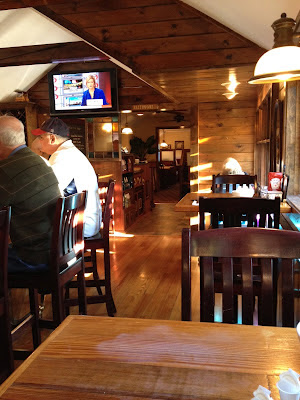
There is a place I often go for breakfast when I spend time on the Cape. To avoid going to a grocery store to buy what I need to make coffee for one morning, I get up at my leisure, shower, and drive five minutes along State Highway 6. The doors of the eatery I head to are open by 6:30, and some weekend visits I am there before 7.
It is an easy menu, uncomplicated. There are listings for daily omelette specials, but I never go that way in my ordering. I nod to the coffee that is offered within two minutes of my being seated. I do not make pancakes at home and I do not know how to make hash so any breakfast out often features one or the other.
I relish the quiet in the paneled tavern room where I sit. Regulars at the counter may chat with the staff, but other early customers like the quiet too. Sometimes I bring a book.
This past weekend on the Cape, I slept in later than usual. I had been visiting with two women the evening before, longtime friends whose wedding I attended in 2004. Their home is tasteful and comfortable, their table a hard place to leave. The evening went easily on as we caught up and dug a little deeper on some issues. Just what old friends do when they have the chance to visit.
At 8 o’clock the next morning I walked into a tavern room that was filling up.
The conversations were no longer just the quiet banter with staff. I heard things I had not planned on hearing, spoken with the bonhomie of professional travelers. One group seated at the counter talked about their college choices fifty and sixty years earlier. For some of the women speaking, college had frankly been a strategy for finding a husband. One well-heeled woman confided that she had known she would have no trouble getting married and so had not considered college for a second.
They sounded like people intent on enjoying themselves. They were glad to have others at hand to whom they could say what they liked.
When I had paid my bill and walked outside to my car, I welcomed the soft cold air of a September morning on the Cape. As I pulled out of my parking spot, I watched three couples from the counter approaching their cars. In each case, a husband walked to the door on the driver’s side; the woman took her time reaching the passenger door.
It looked so clear. As though it would always be this way.
I felt surprised in remembering that it did not need to.
It is an easy menu, uncomplicated. There are listings for daily omelette specials, but I never go that way in my ordering. I nod to the coffee that is offered within two minutes of my being seated. I do not make pancakes at home and I do not know how to make hash so any breakfast out often features one or the other.
I relish the quiet in the paneled tavern room where I sit. Regulars at the counter may chat with the staff, but other early customers like the quiet too. Sometimes I bring a book.
At 8 o’clock the next morning I walked into a tavern room that was filling up.
The conversations were no longer just the quiet banter with staff. I heard things I had not planned on hearing, spoken with the bonhomie of professional travelers. One group seated at the counter talked about their college choices fifty and sixty years earlier. For some of the women speaking, college had frankly been a strategy for finding a husband. One well-heeled woman confided that she had known she would have no trouble getting married and so had not considered college for a second.
They sounded like people intent on enjoying themselves. They were glad to have others at hand to whom they could say what they liked.
When I had paid my bill and walked outside to my car, I welcomed the soft cold air of a September morning on the Cape. As I pulled out of my parking spot, I watched three couples from the counter approaching their cars. In each case, a husband walked to the door on the driver’s side; the woman took her time reaching the passenger door.
It looked so clear. As though it would always be this way.
I felt surprised in remembering that it did not need to.
Tuesday, September 4, 2012
Love and Absence
"Do you really believe in ghosts?"
"Maybe I shouldn't even call them ghosts. It's just stuff you can't see. That I believe in, probably more than most people. Certain kinds of love you can't see. That's what I'm calling ghosts."
A savvy supervisor at work is fond of commenting: “The data always tells an important story.” Numbers. How many people attended a conference session? How many more attended than last year? How many people bought a copy of a presenter’s book after the session?
The data often seems to tell a story that we do well to heed. How many diners rated a restaurant’s cooking as excellent? Very good? Fair? Terrible? How many people found a particular review helpful? How many visitors logged onto a blog in the last twenty-four hours? What’s the largest number of comments to appear on any of this blogger’s recent postings?
Are we doing well?
Are we making it?
Do we have the life we want?
Suppose a novel we were reading challenged the notion that the people we loved were only the people that others could see and count or the people we actually managed to see as often as we wanted? Is there any data we could find to counter the idea that love requires the sight of the beloved?
Because love is never more evident than when the object is absent, that being the time when the beloved’s importance cannot be overlooked, Persian poets in particular dwelt on the pangs of separation to deepen their love of God and thereby draw close to him.
It used to be called The Religions of Man. For the sake of a more enlightened readership, the title was changed to The World’s Religions: Our Great Wisdom Traditions. It is twenty years since I gave the Huston Smith classic my last read before today.
Something made me reach for the text as a diversion during a two-hour session that would call for nothing more than my bodily presence. Today it was just important that someone – anyone – be in a place rather than have it appear unstaffed or unsupervised.
The deeper I read about Sufi mysticism in the chapter on Islam, the more I sensed a world I would not know how to collect data on. The critical question, I understand, is not how many contemporary adherents of the Sufi tradition there are or how many translations of Rumi’s poetry are printed and purchased and made available on library bookshelves and bookstore tables.
Rather…. In a world with so much to count and measure, how does a life ever get to approach absence – or the presence of something you can’t always or maybe ever see – and understand on some level that there is something here to take seriously? That there is a kind of sustenance here that you do not wait for data to validate before you acknowledge your need for it and yield to its power working in you?
"Maybe I shouldn't even call them ghosts. It's just stuff you can't see. That I believe in, probably more than most people. Certain kinds of love you can't see. That's what I'm calling ghosts."
Barbara Kingsolver, Prodigal Summer, page 357
A savvy supervisor at work is fond of commenting: “The data always tells an important story.” Numbers. How many people attended a conference session? How many more attended than last year? How many people bought a copy of a presenter’s book after the session?
The data often seems to tell a story that we do well to heed. How many diners rated a restaurant’s cooking as excellent? Very good? Fair? Terrible? How many people found a particular review helpful? How many visitors logged onto a blog in the last twenty-four hours? What’s the largest number of comments to appear on any of this blogger’s recent postings?
Are we doing well?
Are we making it?
Do we have the life we want?
Suppose a novel we were reading challenged the notion that the people we loved were only the people that others could see and count or the people we actually managed to see as often as we wanted? Is there any data we could find to counter the idea that love requires the sight of the beloved?
Because love is never more evident than when the object is absent, that being the time when the beloved’s importance cannot be overlooked, Persian poets in particular dwelt on the pangs of separation to deepen their love of God and thereby draw close to him.
Huston Smith, The World’s Religions, page 259
Something made me reach for the text as a diversion during a two-hour session that would call for nothing more than my bodily presence. Today it was just important that someone – anyone – be in a place rather than have it appear unstaffed or unsupervised.
The deeper I read about Sufi mysticism in the chapter on Islam, the more I sensed a world I would not know how to collect data on. The critical question, I understand, is not how many contemporary adherents of the Sufi tradition there are or how many translations of Rumi’s poetry are printed and purchased and made available on library bookshelves and bookstore tables.
Rather…. In a world with so much to count and measure, how does a life ever get to approach absence – or the presence of something you can’t always or maybe ever see – and understand on some level that there is something here to take seriously? That there is a kind of sustenance here that you do not wait for data to validate before you acknowledge your need for it and yield to its power working in you?
Sunday, September 2, 2012
September Again
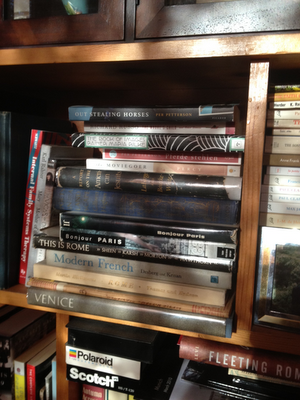
This past Friday morning it was almost September. The sunlight on one of my bookcases at home was like honey.
I realized then how much I wanted September, this great month of beginnings. Some clock had been patiently ticking inside, and I would soon hear the rich chimes again.
The day before I had taken up a volume in my office at day’s end. I had sat beside a table lamp re-reading the first chapter of Edwin Way Teale’s Autumn Across America. Separated from its dust jacket some time earlier, the red-cloth cover was comfort in my hands, the gold lettering of the author’s signature a familiar solace.
The chance last night to attend a screening of the 1963 classic Hud led a friend and me into a favorite university neighborhood. On the way we stopped at a monument to American poet Henry Wadsworth Longfellow. We attempted to identify on the sculpture each of the characters from the poet’s writings.
A few hours later we were walking back from the film. We kept talking about Hud and Lonnie and Alma, their conflicts and tensions, the dust in the black-and-white Texas landscape.
A New England night sky opened above us.
Yes, September had opened within.
I realized then how much I wanted September, this great month of beginnings. Some clock had been patiently ticking inside, and I would soon hear the rich chimes again.
The day before I had taken up a volume in my office at day’s end. I had sat beside a table lamp re-reading the first chapter of Edwin Way Teale’s Autumn Across America. Separated from its dust jacket some time earlier, the red-cloth cover was comfort in my hands, the gold lettering of the author’s signature a familiar solace.
The chance last night to attend a screening of the 1963 classic Hud led a friend and me into a favorite university neighborhood. On the way we stopped at a monument to American poet Henry Wadsworth Longfellow. We attempted to identify on the sculpture each of the characters from the poet’s writings.
A few hours later we were walking back from the film. We kept talking about Hud and Lonnie and Alma, their conflicts and tensions, the dust in the black-and-white Texas landscape.
A New England night sky opened above us.
Yes, September had opened within.
Thursday, August 16, 2012
Citron
I was sneaky, I thought. I was going to find a way to get back into that hotel room. Days and weeks after I had checked out of my vacation lodgings, I would trick my senses with a bar of French soap. Rubbing it across a wet wash cloth back home in New England, I would be back again from a long day of sightseeing, ready to wash away traveler’s fatigue. I would recall the colors of the hotel bathroom, the feel of the tile floor under my feet, the point at the doorway where the vapors of a warm bath mixed with air-conditioning from the bedroom. Hotel living at its most compact and convenient!
I crossed the street corner after I walked out of my hotel that first afternoon. I found a pharmacie with just the thing: Roger & Gallet products in the display window and along the shelves of an étagère. Cédrat was the fragrance I selected, steering clear of soaps that looked too proudly colorful in their packaging. I trusted the images of yellow citrons hanging from their leafy branches. The cashier even nodded in approval of this American’s choice.
One used bar I left in the hotel bathroom after my Paris week. A freshly wrapped soap I packed in my luggage.
With tomorrow morning’s shower I will get to mimic yet again that resolve to make the most of the vacation day before me.
Subscribe to:
Posts (Atom)
.jpg)
.jpg)
.jpg)
.jpg)
.jpg)