It will be time to stand up soon.
Sometimes close to an hour has passed before I get to move from my place in the pew on a Sunday morning. I have sat there and for stretches of time knelt and occasionally stood; I have sung hymns and listened to readings and recited the Nicene Creed; I have exchanged greetings with the other people in my pew and in the pews in front of me and behind.
I have gone through something similar most Sundays of my life. There was a time when my parents and my brothers were the people to the left or right of me in the pew. There were years when classmates from seminary flanked me. For most of my adult life, however, I have entered a church alone on Sunday morning.
On some occasions I have gotten to look out on the pews and the people in them from the vantage point of the sanctuary. When I perform the duties of a Eucharistic minister, I raise a host as each fellow parishioner steps forward in the communion line.
It is something to see one face and then the next and then still another as the line moves toward me.
It is another experience to be in the line. Being in the line is my experience most Sundays these days.
To be in the line, I have to know when to stand up. I stay aware of the people who have been sitting to my left and to my right. Sometimes I have to step over their feet if they are not heading where I am going.
Stepping into the aisle, I may know the person ahead of me in line or I may not. I may know the person behind me or not. I do not need to know either. My glance can sweep over the people already returning to their pews after receiving communion. From the time I was a small child, however, I knew it was better not to let myself be distracted from what I was doing.
What am I doing? That was the stuff of many a grammar school religion class. The early instruction focused on how to hold my hands, at what pace to walk, where to look. Fifty years later I retain a sense that when I enter that aisle, I am joining a walk that is more than getting myself from one location in the church to another.
In recent months, I do not usually enter the aisle alone.
In recent months, I have learned what it feels like when I know a person wants to walk before me or behind me in just this line. In a few minutes, when we return to our places in the pew, we will each of us be aware that the walk was about more than our getting ourselves somewhere in the church and back.
The walk was about getting back to ourselves. Together.
Tuesday, June 24, 2014
Thursday, June 12, 2014
Being Read To
I know I must have been read to on some occasion since I was a child.
I do not mean the kind of reading to which I listen most Sunday mornings when someone looks out over a lectern and shares the scripture passage assigned for that day’s service. Nor do I mean the reading by which a scholar in a lecture hall models for me and others the intonations best suited to unlock the message of a famous orator or poet.
No, for the old-fashioned kind of reading I mean, it will help to picture a Victorian parlor or rustic New England hearthside. Watch the scene unfold as one person, holding open a book or balancing it on her lap, reads while a companion rests his chin on his hand or perhaps closes his eyes, leans his head to the side and listens.
Being read to: it was one of the activities by which an individual during convalescence might pass the time with a minimum of fatigue. My own mind left to wander, however, and my strength of concentration nothing close to what it usually is, I would tire quickly of such bedside readers. I suspect I would even grow depressed imagining how fast I could have gotten through the same page or chapter on my own if I were only once again in the pink of health.
If I go to these examples, I am attempting to explain a kind of reading I am enjoying these days with a particular friend. Sharing a background in teaching and theology, we have taken to choosing books of reflection, spending some time during our visits reading a text aloud to one another. We alternate paragraphs, moving between reading and listening, keeping a steady rhythm, neither rushing nor indulging any excess of expressiveness.
We started with Father James Martin’s My Life with the Saints. We have just finished the opening chapter of Learning to Walk in the Dark by Barbara Brown Taylor.
Neither of us proceeds under the misapprehension that the other could not understand the text perfectly well on his own. The experiment involves observing how making our way through a text with a companion in tow takes on for each of us a bit of the flavor of the companion’s emotional and spiritual journey. We listen and manage to hear more than the author’s words. We hear a friend when he does not get to choose the words by which he will communicate.
It is a subtle flavoring that I am talking about, to be sure. There are times, however, when I look up and wonder why I would not have asked for this pleasure before from other friends in my life.
I am enjoying being read to again.
Wednesday, June 11, 2014
House Envy
I just listened to a new colleague tell a story about a conversation she had had last night with someone who lives, I was told, right next to the house I own on Cape Cod. In the course of their conversation my colleague had heard all about being invited over for drinks at my house. “And what a wonderful house it was!” She seemed happy to pass that compliment on to me.
I have no problem accepting compliments except that I do not own a house on the Cape.
I knew almost immediately the person I had been mistaken for – another colleague, complete with grey beard.
It had been hard to find a moment early in the narration of the conversation at which I could have interrupted. Instead I got to enjoy the look of slight envy that my new colleague leveled at me at the close of her story. I briefly imagined what it would feel like to be complimented on a beautiful house on the Cape. I remembered what it had felt like to accept compliments on a 1920 Arts and Crafts home I had co-owned until six years ago.
House envy.
Since I am no longer a homeowner of any stripe and since the prospect of ever being one again appears distant and unrealistic, I felt funny just now being mistaken for one. I have moved somewhere in my life, I understood afresh.
I mix with people on a daily basis who cannot imagine that move or the circumstances that would bring it about.
The truth is that I meet more and more people who can and do. Like mine, their status can remain long undetected. A door has, nonetheless, opened for them and for me. Just beyond it is a walkway into a future around which there are fewer guarantees but a certain kind of ease.
You do not know you want it until it appears.
Wednesday, May 14, 2014
Lo, the winter is past...
“Bare trees imprinted the black lace of their twigs on a gray and somber sky. Dingy with soot, snowdrifts had melted into slush and were freezing again… February, at once the shortest and longest month of the twelve, had outstayed its welcome. The year seemed stuck on the ridge of winter.”
Chapter One of Edwin Way Teale’s North with the Spring begins with that paragraph. It is odd in the middle of May to read that description of winter and remember back just twelve weeks to a February much like the one Teale evokes.
This was a winter that left me feeling stuck.
I should have been moving forward. For several months I had thought I was. The holidays and birthdays had brought out lots of creativity, and I was writing with a renewed sense of touching readers – maybe one reader in particular.
And then the reading stopped. It stopped in mid-February. After shoveling out another man’s car, clearing the snow off his windshield and roof time and again, the parking spot was mine again.
I had left a hardcover copy of The Lost Woods, one of my favorites of Teale’s works, on a bookcase in a Connecticut home. It may stay there a long time for all I know. Or it may show up in a post-office mailer another three months down the line.
I do know it is May and the landscape outside my front door has changed. The windows stay open for hours at a time on some evenings. On other days, the morning air keeps a chill from the night before.
Favorite meals have showed up on my dining room table two and three times over the past twelve weeks. When a friend sits across from me and shares them, I find myself at ease looking ahead to summer.
I recently picked up a novel entitled Night Train to Lisbon. I love Pascal Mercier’s portrait of a teacher in his late 50s at a moment of unexpected transition. I find myself searching airline fares to Lisbon. I find myself expecting again a future as exciting as any I could ever want.
“The seasons, like greater tides, ebb and flow across the continent. Spring advances up the United States at the average rate of about fifteen miles a day. It ascends mountainsides at the rate of about a hundred feet a day. It sweeps ahead like a flood of water, racing down the long valleys, creeping up hillsides in a rising tide.”
Lo, the winter is past.
Sunday, April 13, 2014
Holy Week 2014
Imagine knowing you are going to do something clumsily if you try it and yet doing it anyway. What could this mean? Either the outcome does not particularly matter to you or the issue at the heart of any outcome is so important that you cannot not try.
I remember reading this passage by a spiritual writer who died in 1914: “Meditate on the Passion, no matter how unskilfully, how clumsily, virtue will come out from it to us, to heal and to strengthen.”
For a religious superior who returned so often to “right thinking about God” as key to an individual’s progress in prayer and the spiritual life, Mother Janet Erskine Stuart seemed to have taken an intellectual humility pill before writing what she did.
Was she up against fellow sisters who continually lamented their failure of imagination in meditating on the final days of Jesus? Were these women who despaired of matching in their personal prayer the stirring detail by which retreat directors had moved them to tears in their preaching about the sufferings of Jesus?
Mother Stuart would have understood what Pope Francis sent out on Twitter last week: “How beautiful it is to stand before the Crucifix, simply to be under the Lord's gaze, so full of love.”
For that matter, I understand it.
Raised – like the Pope – at a time when the Way of the Cross was a devotion that filled parish churches during Lent, I recall the language of the prayers attached to the fourteen scenes arranged along the walls of the church. Through that language I learned that my response to the sufferings of Jesus was something by which Jesus would be comforted. I learned, in other words, that a relationship already existed between this man of sufferings and myself and that the relationship mattered to him.
How does that relationship matter to me as a man in his early sixties?
I am looking for analogies, but I am not sure I will be entirely successful. I would have to understand things in my history better than I do to propose an analogy that will help my life with Jesus make sense in print.
It is Holy Week, however. I look forward to the services. I look forward to sitting with people who can meditate as clumsily as I.
I remember reading this passage by a spiritual writer who died in 1914: “Meditate on the Passion, no matter how unskilfully, how clumsily, virtue will come out from it to us, to heal and to strengthen.”For a religious superior who returned so often to “right thinking about God” as key to an individual’s progress in prayer and the spiritual life, Mother Janet Erskine Stuart seemed to have taken an intellectual humility pill before writing what she did.
Was she up against fellow sisters who continually lamented their failure of imagination in meditating on the final days of Jesus? Were these women who despaired of matching in their personal prayer the stirring detail by which retreat directors had moved them to tears in their preaching about the sufferings of Jesus?
Mother Stuart would have understood what Pope Francis sent out on Twitter last week: “How beautiful it is to stand before the Crucifix, simply to be under the Lord's gaze, so full of love.”
For that matter, I understand it.
Raised – like the Pope – at a time when the Way of the Cross was a devotion that filled parish churches during Lent, I recall the language of the prayers attached to the fourteen scenes arranged along the walls of the church. Through that language I learned that my response to the sufferings of Jesus was something by which Jesus would be comforted. I learned, in other words, that a relationship already existed between this man of sufferings and myself and that the relationship mattered to him.
How does that relationship matter to me as a man in his early sixties?
I am looking for analogies, but I am not sure I will be entirely successful. I would have to understand things in my history better than I do to propose an analogy that will help my life with Jesus make sense in print.
It is Holy Week, however. I look forward to the services. I look forward to sitting with people who can meditate as clumsily as I.
Tuesday, April 1, 2014
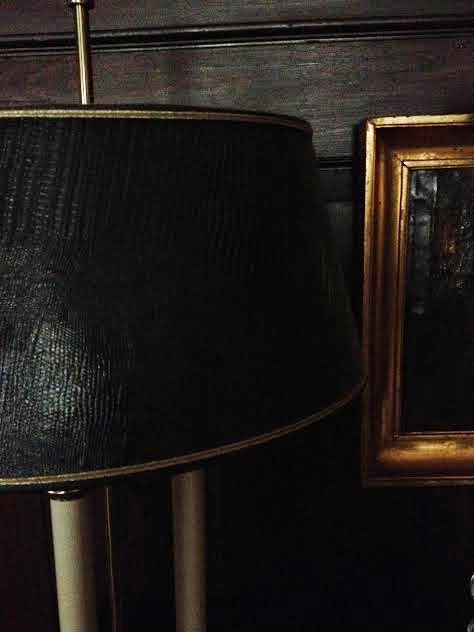
Lampshades
Look at them.
I do every time I visit my brother’s house in New Orleans. They are familiar from visits over the years, but last week I determined to make a record of some of the lampshades with which my brother in his decorating avoids the obvious and predictable – again and again
.
He knows how to invite attention. Because he has paid attention to detail, others pay attention. Because he has varied shape and size and color and edging and pattern and fabric, the lampshades in his home invite visitors to join in a certain playfulness. Watch where I go, they seem to say. Did you expect this, they almost ask.
Avoiding the obvious and predictable is something I strive to do when I write. In my experience, good writing is not the result of merely decorative words, however. It is not the unusual word for the sake of variety. More often than not, power of expression emerges when a writer with simplicity names what might not even have occurred to a reader as worthy of expression. Yes, the reader confesses, that is in fact how something in my world feels, how it looks, how it claims attention or sometimes even deflects it.
I suddenly notice. I almost involuntarily respond.
Tricked by the simplest of words, I recognize my world. I enter my own life.
My heart can feel called to attention.
Friday, March 14, 2014
Stunned by a Paragraph III
From Sussex by Esther Meynell
Each Sussex man or woman has one particular place or aspect in the county that above all others means Sussex. For me, in spite of a personal preference for the Eastern Downs, it is Chanctonbury, but Chanctonbury from far away. It was that blue view of Chanctonbury which gave me in childhood my first conscious feeling of the beauty of the visible world and the mystery of the invisible. Standing in the rough matted grass of a neglected field, looking westward, with the great line of the Downs sweeping towards a sunset sky where the headland of Chanctonbury floated like something of another world, beauty took hold of me, consciously and inescapably – the curious ache of it, and the troubling for the first time laid on the young resilient heart.
Thursday, March 13, 2014
New York Weekend
I am this side of a weekend in New York City.
The last time I visited the city was over three years ago. I was taking part in a conference in October 2010 on the Columbia campus. Travelling with colleagues, I managed some time on my own. One evening I attended a play written in rhyming couplets about a seventeenth-century French dramatist modeled on Moliere. I took the bus down from Columbia another day and strolled through the Neue Galerie on the Upper East Side.
A year earlier I had made a summer visit to a friend in the City. She and I sat gaping during one matinee performance of Mary Stuart while the heroine opened her arms to a rainstorm onstage. A poet and writer and librarian, my friend agreed to join me in journaling in the Reading Room of the New York Public Library; we took seats outside the library later and read to one another what we had written.
In the city on various occasions over the past three decades, I have strolled through Greenwich Village on numerous evenings with friends from New Jersey, attended Madama Butterfly at the Met for my fortieth birthday, went to Mass again and again at St Francis Xavier near Washington Square, and haunted the aisles of the Strand Book Store.
If I review New York memories at this point, it is to be able to step off the bus this Saturday morning and greet the friend meeting me and match his pace across town to lunch. No standing with a map, no squinting up at street signs. Just a weekend in the City. Just good conversation and unhurried eating. How did I get this lucky again?
Thursday, February 27, 2014
Eating Out
It happened again this week. Without seeking them out, I got to hear two people I know talking about a restaurant to which they had gone, each on a different day. It was restaurant review time. They had stopped near where I happened to be, and I do not know if they realized that I could hear them. I would not have given attention to what they were saying except I heard one of them saying something I had heard her say before in just this context: “I have to admit I was disappointed.”
Without seeing her, I could picture her at that moment. She would be leaning her head in and turning it slightly as though she were sharing something confidential.
What I knew was happening was that these two people had each ventured out to a restaurant and paid sixty or seventy dollars for a meal. Maybe more. As part of what they had paid for, a certain future frisson was their right. They could, if they wished, shudder with disappointment at their costly evening.
The bald truth is, they had been willing to incur significant expense for the chance to test the publicity, the advertising, the online reviews, the word of mouth among their acquaintances. There used to be times when I did the same thing, when I enjoyed the advantages of a two-income household. Was there resentment on my part this week hearing people with the freedom to be disappointed after a significant expense on what was actually a non-necessity? Was it that they had what I did not have, that they got to do what I could not?
No, that was not where my thinking was going. Not where my feeling was going as I overheard these two people. I frankly was thinking of all the perfectly satisfying meals I have had the good fortune to enjoy, meals that did not claim anything near sixty or seventy dollars. Some of them were meals ordered out in restaurants, but a whole lot more were prepared in my own kitchen and served at my dining room table.
Another little chink has been introduced into my ideas about how to spend money. What do I benefit from spending sums that I do not have to pay? Why do I and others venture so often to want more? What curiosity motivates us to look elsewhere when the satisfactory is so near and sometimes so easy?
How many priceless memories surround meals where the person across from us was the food we most needed?
Friday, February 14, 2014
Expectant Hearts
“Do you really believe that?”
If I mention at the lunch table something that I have seen on a television series the night before, no one asks me the question “Do you really believe that?” My colleagues do not suspect any extremes of technological naiveté on my part. I can profess admiration for Dr. John Watson’s loyalty in the newest PBS version of the Sherlock Holmes story, and lunch companions simply learn a little more about how I spend my evenings. They may glimpse something of my sympathies and values. They do not appear inclined to test my hold on reality.
“Do you really believe that?”
An inveterate reader of poetry is trained to imagine things. It is a tribute to the poet Mary Szybist that she can get me to picture the pigeons and doves she saw gathering one day in an ash tree in Bellagio, Italy. That is, if there really had been an ash tree. If there really had been birds that hopped from branch to branch one day while the poet watched them. Accepting the conventions of imaginative literature, I am eventually moved by a life truth that the writer, bereaved and far from home, manages to convey through just those images.
“Do you really believe that?”
I grew up within a religious tradition with holy cards and a calendar of holy days. I grew up familiar with what a grotto might look like although I had never seen one. (Louisiana does not boast natural caves.) Very young, I learned the narrative about a grotto in southern France and a presence there to which an impoverished young girl had responded in the nineteenth century. I heard of subsequent pilgrim journeys and healings and hearts that were expectant as passengers looked out the windows of trains travelling into the French Pyrenees. When February 11 comes and goes each year, I get a reminder that it is human to be full of need and full of expectation.
I really believe that.
Subscribe to:
Posts (Atom)